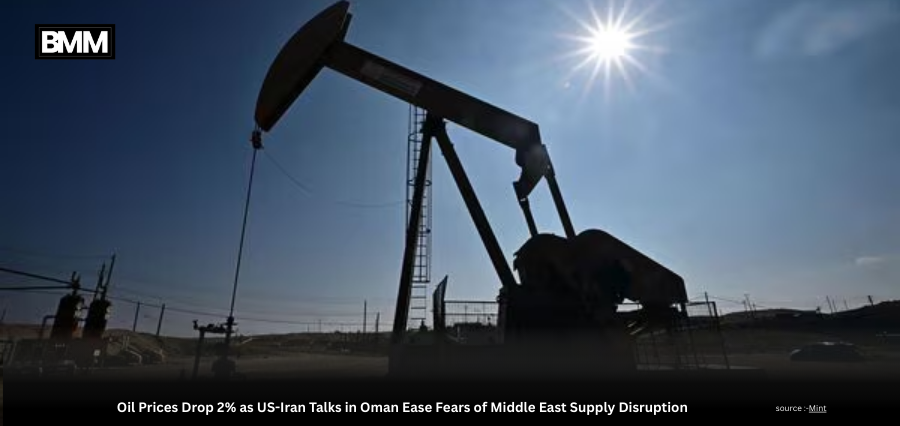
Global oil prices fell by about 2% on Thursday after the United States and Iran agreed to hold talks in Oman, easing fears that a military confrontation could disrupt crude supplies from the Middle East. The move erased part of the recent geopolitical risk premium that had been priced into markets, highlighting how closely US-Iran talks oil prices remain linked to diplomatic developments.
Brent crude futures dropped $1.44, or 2.07%, to $68.02 per barrel by the time Asian trading started. U.S. West Texas Intermediate (WTI) crude dropped $1.34, or 2.06%, to $63.80 per barrel. The market fell back after a week of volatile trading, which was caused by uncertainty about whether the talks would happen.
Volatility Triggered by Conflicting Signals
On Wednesday, oil prices jumped almost 3% after news reports said that the planned talks between Washington and Tehran might fall through. That rally was a sign of new worries about things getting worse in a part of the world that makes a lot of oil. However, later statements from officials on both sides confirmed that talks would go ahead on Friday in Oman, even though the agenda hasn’t been set yet.
“The oil price has erased part of the geopolitical risk premium on the news of US-Iran talks in Oman,” said Mukesh Sahdev, CEO of energy consultancy XAnalysts. His comments underline how quickly US-Iran talks oil prices react to shifts in diplomatic tone.
What’s at Stake in the Negotiations?
Despite agreement on holding talks, significant differences remain between the two sides. Iran has said that it is willing to talk with Western countries about its nuclear program, which includes enriching uranium. The US, on the other hand, wants a bigger agenda that includes Iran’s ballistic missile program, its support for armed proxy groups in the Middle East, and its record on human rights at home.
Analysts caution that these wide gaps could limit progress. “It is likely that these talks will surface new differences and the risk premium will rise again soon,” Sahdev said. Such an outcome could once again push US-Iran talks oil prices higher if markets perceive an increased risk of confrontation.
Lingering US-Iran talks oil prices Fears of Military Action
Even though diplomacy is back on the table, people are still worried that Donald Trump could still follow through on his earlier threats to attack Iran. Iran is the fourth-largest oil producer in the Organization of the Petroleum Exporting Countries (OPEC). If its production were to stop, it could have big effects on the supply of oil around the world.
A military conflict could also spill over to neighboring producers, amplifying the impact. These risks mean US-Iran talks oil prices may remain volatile in the coming days as traders assess both diplomatic progress and the likelihood of escalation.
Strait of Hormuz Remains a Key Risk Point
The Strait of Hormuz is a key chokepoint for about a fifth of the world’s oil consumption, so markets are keeping an eye on it. The narrow waterway between Oman and Iran is very important for exports from the biggest Gulf producers.
Countries such as Saudi Arabia, the United Arab Emirates, Kuwait, and Iraq ship most of their crude through the strait, as does Iran itself. Any disruption there would have an outsized effect on US-Iran talks oil prices and global energy markets.
Broader Market Pressures Add to Decline
On Thursday, oil wasn’t the only thing that was under pressure. Analysts said that the strength of the U.S. dollar and the increased volatility of precious metals made people feel less risky overall. When the dollar gets stronger, it usually makes commodities priced in dollars, like oil, more expensive for people who hold other currencies. This puts more downward pressure on prices.
These financial factors compounded the impact of easing geopolitical concerns, reinforcing the decline in US-Iran talks oil prices during the session.
Outlook: Diplomacy vs. Risk Premium
For now, the confirmation of talks has calmed markets, but few analysts expect a smooth path ahead. With major disagreements unresolved and the risk of military action still present, oil prices are likely to remain sensitive to headlines.
As traders balance diplomatic optimism against structural risks in the Middle East, US-Iran talks oil prices will continue to serve as a barometer of global energy market anxiety.
Also Read :- Heads to the Polls in a High-Stakes Three-Way Thailand Political Battle