
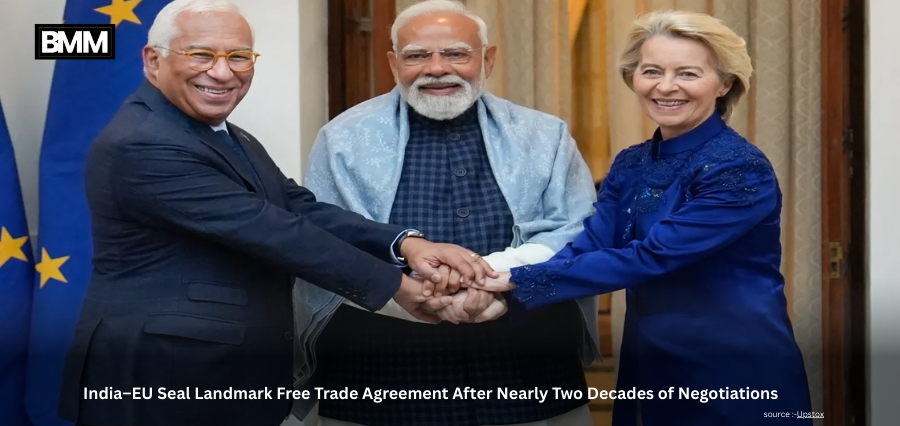
India and the European Union have announced a historic free trade agreement (FTA), ending nearly 20 years of on-and-off negotiations. The India–EU Trade Deal is being hailed as one of the most significant global trade agreements in recent years, coming at a time of rising geopolitical tensions and economic uncertainty linked to strained relations with the United States.
The agreement was unveiled during a bilateral summit in New Delhi, attended by European Commission President Ursula von der Leyen, European Council President António Costa, and Indian Prime Minister Narendra Modi.
Calling it a breakthrough moment, von der Leyen said the two sides had delivered “the mother of all deals,” while Modi described the pact as “historic” and transformative for India’s economy.
Scope of the India–EU Trade Deal: Market of Two Billion People
The India–EU Trade Deal enables free trade in goods and services between the EU’s 27 member states and India — together accounting for nearly 25% of global GDP and a combined market of around two billion people.
In addition to trade liberalisation, the pact includes provisions covering investment flows, supply-chain integration, professional mobility, and a parallel security and defence partnership, signalling a broader strategic alignment between the two sides.
Major Tariff Cuts on Automobiles, Machinery and Chemicals
One of the most significant aspects of the agreement is the scale of tariff reductions.
The European Union will eliminate tariffs on most exports of:
- Chemicals
- Machinery and electrical equipment
- Aircraft and spacecraft
India has agreed to sharply reduce import duties on EU-manufactured motor vehicles, cutting tariffs from levels as high as 110% to 10%, under an annual quota of 250,000 vehicles. This quota is substantially higher than similar concessions offered to other trading partners.
India will also lower tariffs on European products such as wine, beer and olive oil, expanding access for EU agricultural and lifestyle exports.
Indian Exports to Gain Preferential Access to EU Markets
From India’s perspective, the agreement offers major opportunities for export-driven sectors. The government said almost all Indian exports will receive preferential access to European markets.
Key beneficiaries include:
- Textiles and garments
- Leather goods
- Marine and seafood products
- Handicrafts
- Gems and jewellery
Commodities such as tea, coffee, spices and processed foods are also expected to see reduced or eliminated tariffs.
However, India has chosen to protect sensitive domestic sectors, including dairy, cereals, poultry, soy meal and certain fruits and vegetables, balancing export growth with internal economic priorities.
Mobility Framework to Ease Professional Travel
A dedicated mobility framework forms another important pillar of the agreement. It will ease short-term travel and work restrictions for professionals between India and the EU, benefiting service providers, skilled workers and businesses operating across borders.
Prime Minister Modi said the pact would boost manufacturing, services and innovation partnerships, while improving market access for Indian farmers and small businesses.
Geopolitical Context: India–EU Trade Deal Amid US Tariff Pressures
The agreement comes against a backdrop of heightened global trade tensions. Both India and the EU have faced economic pressure from the United States, including higher tariffs imposed under President Donald Trump’s administration.
European leaders said the deal sends a strong political message favouring cooperation over protectionism. António Costa noted that India and the EU believe in trade agreements rather than tariffs, without directly naming the US.
Challenges and Opportunities for Indian Industry
While experts say the deal could significantly benefit labour-intensive sectors such as shrimp farming and textiles, some analysts warn of challenges related to EU regulatory and environmental standards, particularly on climate compliance and carbon mechanisms.
Economists stress that Indian manufacturers will need to upgrade processes and sustainability practices to fully capitalise on the agreement.
Next Steps: Approval and Strategic Expansion
The India–EU Trade Deal must still be approved by the European Parliament and EU member states, with formal signing expected later this year. Compared to other recent EU trade agreements, analysts say the India pact is less politically contentious.
Alongside trade, India and the EU are advancing talks on security, defence cooperation, maritime security, cyber threats and climate action, reinforcing the deal’s strategic importance.
As negotiations that began in 2007 finally conclude, both sides see the agreement not as an endpoint, but as a foundation for a deeper and long-term partnership.
Also Read :- $5 Billion Debanking Lawsuit Puts JPMorgan and Jamie Dimon Under Legal Spotlight