
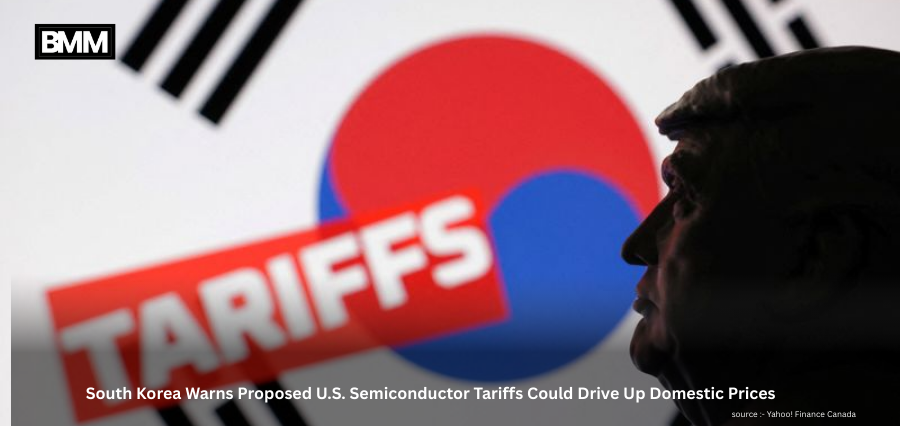
South Korean President Lee Jae Myung on Wednesday downplayed concerns over proposed US semiconductor tariffs, warning instead that steep duties would ultimately hurt American consumers. Speaking at a press conference, Lee said that imposing tariffs as high as 100% on imported chips would almost certainly push prices higher in the United States due to the overwhelming dominance of Asian chipmakers in the global market.
“If you impose a 100% tariff, prices will inevitably rise,” Lee said, noting that South Korean and Taiwanese firms control nearly 80–90% of key semiconductor segments. “Most of it is likely to be passed on to U.S. prices.”
His remarks come amid intensifying debate in Washington over the use of US semiconductor tariffs as a strategic tool to bring chip manufacturing back onto American soil.
Washington’s US semiconductor tariffs Threat and Asia’s Chip Dominance
The comments came after U.S. Commerce Secretary Howard Lutnick said that South Korean and Taiwanese chipmakers could have to pay tariffs of up to 100% if they don’t significantly increase production capacity in the U.S.
Samsung Electronics and SK Hynix from South Korea are the biggest players in the global memory chip market. Taiwan’s TSMC is the leader in contract chip manufacturing. These companies are the backbone of the global semiconductor supply chain, so US semiconductor tariffs could have a big effect on them.
Lee said that South Korea’s trade agreement with the U.S. already has protections in place to make sure that its chipmakers are not at a disadvantage compared to Taiwanese or other global competitors.
Export Boom Underscores Semiconductor Leverage
South Korea’s chip industry is very important to the country’s economy, as shown by its strong export performance. Exports from the country reached an all-time high of $709.4 billion in 2025, a 3.8% increase from the year before. This was mostly due to a 22% rise in semiconductor shipments, which were driven by a surge in artificial intelligence investment.
Semiconductor exports totaled $173.4 billion, with the United States accounting for 8% of that figure. China remained South Korea’s largest chip export destination, followed by Taiwan and Vietnam. Analysts say these figures underscore why US semiconductor tariffs could reverberate well beyond bilateral trade, reshaping global supply chains and pricing structures.
Won Under Pressure, Markets Still Undervalued
Lee also talked about how the South Korean won has been weak lately. He said that the government expects the currency to get stronger and reach the 1,400-per-dollar level in the next two months. He did, however, warn that domestic measures alone might not be enough to stabilize foreign exchange markets, pointing out the won’s connection to the Japanese yen.
Lee said that South Korea’s stock market was undervalued, even though the currency was unstable. The benchmark index went up 76% last year, making it the best-performing market in the world. Lee, on the other hand, said that the fundamentals are still stronger than the current valuations suggest.
A Pragmatic Push for North Korea Talks
Lee said he was working on diplomatic efforts to get the US and North Korea talking again, and he said he was taking a practical approach. He said it was unrealistic to think that Pyongyang would give up all of its nuclear weapons, but he did say that stopping the production of nuclear materials and the development of missiles would still make the world safer.
Lee said that North Korea makes enough nuclear material each year to build 10 to 20 nuclear weapons. Since 2019, when former U.S. President Donald Trump met North Korean leader Kim Jong Un, talks between Washington and Pyongyang have stopped.
Drawing a Firm Line on Religion in Politics
In a separate but pointed remark, Lee underscored the importance of maintaining a strict separation between religion and state affairs. “The principle of separation of church and state should never be broken,” he said, adding that violations must be “punished strictly.”
As debates over US semiconductor tariffs intensify, Lee’s comments signal South Korea’s intent to defend its economic interests while warning Washington that protectionist measures may ultimately backfire, by raising prices at home and unsettling a highly interdependent global industry.
Also Read :- Renault Reports Higher Sales on Strong International Demand