
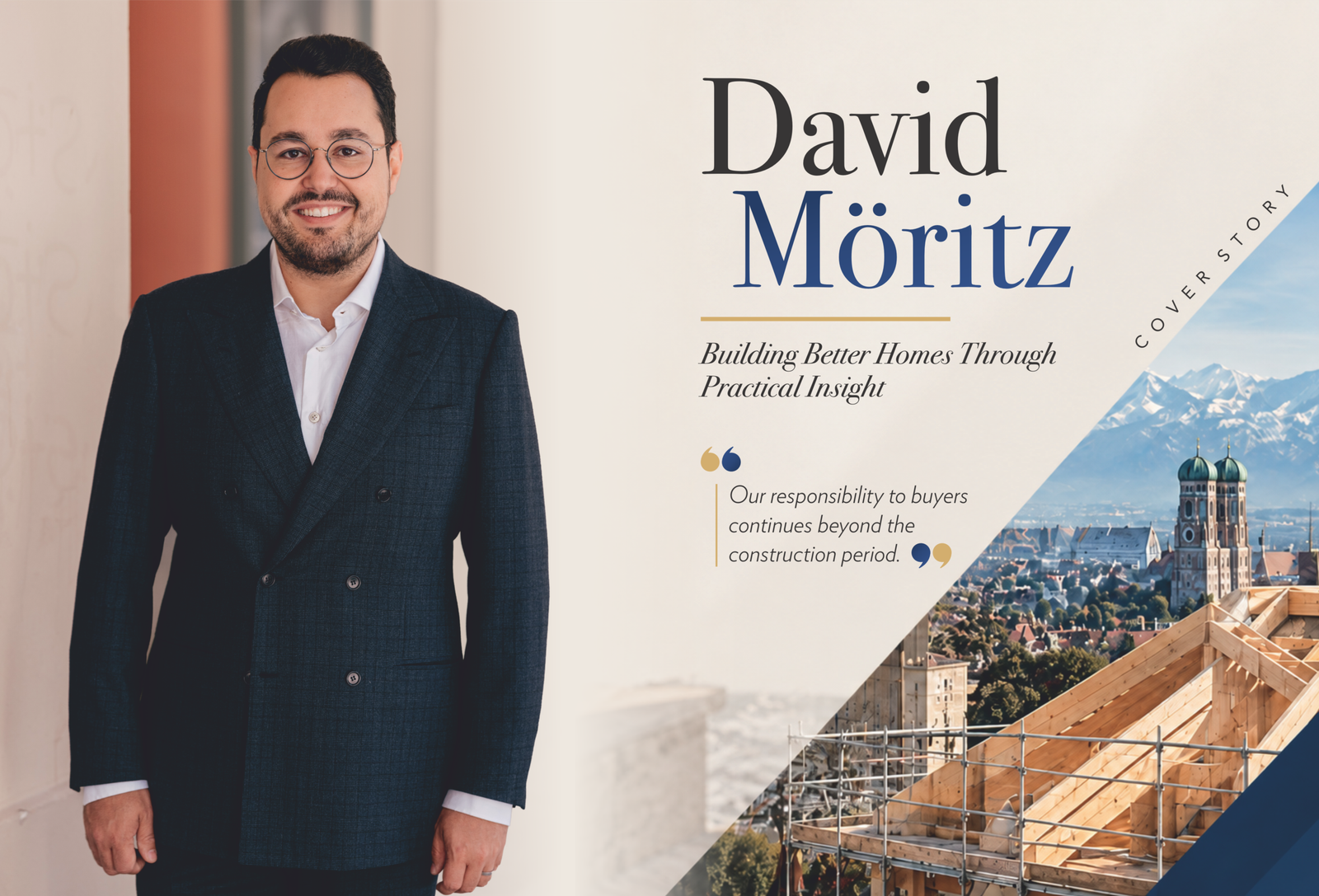
David Möritz’s approach to property development began with the work itself: understanding how a building comes together, what each trade requires and how decisions made on site affect the finished home. When he founded a construction company in 2017, he did not want to rely on plans and cost estimates alone. He taught himself practical skills, including laying tiles and building drywall partitions, through books, videos and time on building sites. Learning how the work is actually done gave him a lasting appreciation for the expertise of tradespeople and for the connections between preparation, quality, cost and timing. It also taught him to test an attractive idea against the realities of delivering it.
That practical grounding continues to inform David Möritz’s work as Managing Director of Better Real Estate GmbH. His experience spans construction entrepreneurship, asset management and property investment, giving him a view of development that connects the needs of future residents with the realities of planning, financing and construction. Working alongside founder Andreas Schmid and the existing team, he is helping the company expand its residential portfolio from its Munich base while maintaining a clear focus on feasibility, lasting housing quality and responsible financial decisions.
From the Building Site to the Boardroom
David began his professional journey by acquiring and renovating older buildings in Berlin. In 2017, he founded a construction company specialising in refurbishment, attic conversions and energy-efficiency upgrades. By the time he sold the business in 2021, it had grown to 25 permanent employees. Running the company meant taking responsibility for both commercial decisions and the people who had to deliver the work on site.
After selling the company, David moved into asset management, first at Coros and then at Forte Capital, where he became Senior Asset Manager responsible for residential and commercial properties. His work included reducing vacancy and delivering modernisation projects. The experience reinforced a lesson that had already emerged in construction: an investment assumption is only credible when it reflects a building’s condition, the work required and the time needed to complete it.
In April 2025, David became Managing Director of Better Real Estate GmbH. His background as an entrepreneur, investor and asset manager now informs decisions across acquisition, planning, financing and construction. He also values the experience already within the company, whose understanding of Munich and its surrounding areas provides an important foundation for the next stage of development.
Strengthening the Business for Sustainable Growth
When David took over as Managing Director, the priority was to bring more of Better Real Estate’s projects into construction while building the financial and organisational capacity to manage them well. Expansion required more than acquiring sites: every development created commitments involving funding, people, contractor coordination and financial oversight. Financing and organisational development therefore had to progress together.
A substantial part of the work involved renewing discussions with existing banks and establishing relationships with additional financing partners. “We secured development funding in the millions of euros, which has been an important achievement in the demanding lending environment of 2026,” David explains. The broader network gives Better Real Estate more options when arranging finance for individual projects, whose capital requirements vary according to construction stage and the timing of expenditure and sales.
The company also strengthened project controlling and liquidity planning, introduced digital invoice approvals and improved construction documentation. These measures help colleagues see the financial consequences of decisions, including commitments that have not yet resulted in an invoice. A project may remain within its overall budget while the timing of contractor payments still requires careful management; a clearer view of upcoming cash requirements supports more informed decisions about what the company can commit to next.
The team has grown from seven to 18 people and now manages five construction projects comprising 41 residential units. Because Better Real Estate appoints individual trades directly, coordination and clear responsibilities are especially important. Colleagues, including those working on site, were involved in selecting the systems and processes introduced across the business, ensuring that the changes reflect the practical demands of day-to-day construction.
Since David joined in April 2025, Better Real Estate has also recorded €26 million in notarised sales of residential property and land. This sales performance owes a great deal to founder Andreas Schmid, who leads sales, and the colleagues supporting those transactions.
“I am particularly proud of the team for achieving that progress while also taking on the work of expanding and reorganising the business.”
Reading Munich Through the Lives People Want to Lead
Residential development begins with understanding the relationship between a neighbourhood, the people who want to live there and the homes that can realistically be delivered. Munich’s projected population growth supports a long-term need for housing, but affordability remains a decisive consideration. City figures for the first half of 2026 showed asking rents rising alongside slightly lower asking prices for apartments, underlining the need to assess purchasing power rather than relying on demand alone.
Location is more than a point on a map. Access to workplaces, schools, childcare, public transport and green spaces influences whether a home will suit its residents over time. These everyday connections help determine which housing type is appropriate for a particular neighbourhood and audience, and whether the finished development will offer a convincing proposition at its intended price.
The development on Betschartstraße in Pasing illustrates this approach. Better Real Estate is creating four semi-detached homes within walking distance of Pasinger Stadtpark, with schools, shops and rail connections nearby. The setting supports a family-oriented concept, while Fabian Schmid, the company’s head of planning and the project architect, translates the needs of future residents into practical home designs.
At Aichacher Straße in Sendling-Westpark, the company is developing 20 student apartments. Here, proximity to educational institutions and public transport, efficient layouts and total monthly housing costs shape the proposition. Although the apartments are purchased as investments, their long-term performance depends on whether they work well for the students who will live in them.
Each project must also be judged against the alternatives available to prospective residents, whether an existing property nearby or a new home elsewhere in the region. As David puts it, “Each development needs a convincing reason for someone to choose it at the proposed price.” Current market evidence, a suitable location and a home designed around its intended residents provide a stronger basis for committing to a project through changing conditions.
The Practical Economics of Building Well
David’s experience in construction and finance informs how he assesses a development’s commercial potential. Projected returns depend on assumptions about construction methods, what each contract includes, the sequence of work and the time required to complete it. These assumptions are reviewed with the team, particularly where one trade depends on another, because a decision about sequencing can affect both the final cost and the period for which capital remains committed.
Comparing contractors’ offers requires looking beyond the headline price. Preparatory work, scaffolding, cranes and other equipment may be shared across several trades, even after the contractor who arranged them has finished its own work. Understanding these dependencies helps the team compare like with like and avoid apparent savings that simply shift a cost or obligation elsewhere in the project.
Temporary weatherproof roofing is another planning consideration when interior work needs to proceed before the permanent roof is complete. The protection must be suitable for site conditions and coordinated with the trades working beneath it. Its cost should be weighed against the risk of interruptions, prolonged equipment hire and additional financing costs. As David explains, “In evaluating a proposed saving, I therefore consider what it could mean for subsequent work and for the finished home.”
Quality control has a similar financial dimension. Waterproofing and building services need to be inspected before subsequent work conceals them. Finding a defect while the relevant element remains accessible can prevent expensive repairs, reopening finished areas and bringing several trades back to site. The value of a decision must therefore be judged not only by its immediate cost but also by what it means for the completed home and its future occupants.
These assessments bring together Laura Scholl, the company’s head of finance, and colleagues responsible for planning and construction. The people closest to the work evaluate practical feasibility, while finance considers the effect on project returns and funding requirements. David’s responsibility is to connect those perspectives and ensure that budgets and schedules reflect the realities identified by the people delivering the project.
Digital Systems That Support Better Decisions
Better Real Estate has introduced digital tools to make project information easier to access, clarify responsibilities and help colleagues resolve issues without unnecessary delay. Their value lies in giving teams a shared, reliable record of what has happened and what needs to happen next.
BauMaster enables colleagues to record observations and photographs directly on site and assign responsibility for follow-up. This creates a useful record of what has been identified, who must act and whether the issue has been resolved. It also supports clearer communication with contractors and buyers when a question needs to be revisited.
In finance, Alasco provides a structured process for invoice approvals and makes supporting information easier to retrieve. The team can see where an invoice stands and which reviews remain outstanding, allowing finance colleagues to focus more closely on cost movements and upcoming cash requirements.
The company also uses absence.io for personnel administration, including working-time records, payroll documents and absence planning. By simplifying routine tasks, the system reduces administrative interruptions and makes it easier to organise cover.
Technology is useful only when the information it captures is accurate and followed through. Recording that a contractor has been contacted, for example, is not the same as confirming that the work has been completed and checked. Clear documentation must reflect the status of the work rather than create an impression of progress.
The aim is practical: colleagues should be able to understand an issue, identify the next action and move it forward. Digital tools support professional judgement; they do not replace it. By improving visibility and accountability, they give the team more time to focus on decisions that affect delivery and housing quality.
Understanding What a Site Can Really Deliver
Better Real Estate focuses on Munich and the surrounding area, assessing established neighbourhoods, redevelopment opportunities and sites where additional housing may be possible. Each potential acquisition begins with a feasible housing concept and a clear view of who might buy or occupy the homes, at what price and why the location would suit them. The acquisition price then has to be tested against the development potential the site can realistically support.
Where a site has a preliminary planning decision (Bauvorbescheid), the team must understand precisely which questions it resolves and which still require approval. Planning colleagues assess the permitted building volume and how much of it can become usable residential space after accounting for circulation areas, technical rooms and parking. These calculations influence the economics of a site and the price the company is prepared to pay.
Physical conditions can materially alter a project’s costs. Groundwater, demolition, contamination, construction access and excavation support all require assessment, particularly on constrained urban plots where neighbouring buildings may need protection. Technical specialists help identify these risks while there is still time to reflect them in acquisition negotiations.
The financial assessment starts with the expected value of the completed development. Construction costs, professional fees, financing, contingencies, transaction expenses and an appropriate return must then be accounted for. Time is also a cost: capital remains committed between acquisition and construction, and any additional development potential must be weighed against the time and expenditure required to secure it.
In some cases, Better Real Estate considers arrangements in which a landowner receives a completed apartment as part of the purchase consideration. This can appeal to someone who wants to remain in the same neighbourhood, but the specification, delivery obligations and value of the apartment must be assessed as carefully as a cash payment.
Risk Management Before Costs Escalate
Development risk is shaped by the relationship between expected returns and the capital needed to carry a project through construction and sale. Slower sales can extend the financing period, increase interest expenses and leave more capital tied up. If selling prices also come under pressure, the impact can be greater. Better Real Estate therefore tests how changes in construction costs, sales prices, interest rates and completion dates could affect a project’s viability.
Financing agreements need to be examined beyond the interest rate. Conditions for drawing funds, repayment schedules and the lender’s valuation all affect how a development is funded. If construction costs rise while the lender’s valuation falls, the company’s equity requirement may increase. Forecasts must also reflect when buyer payments become payable and how the financing agreement treats those receipts.
Because Better Real Estate appoints individual trades, the company must monitor both the cost of outstanding work and each contractor’s ability to fulfil its commitments. A contractor’s failure can mean appointing a replacement at a higher price and disrupting subsequent activities. Updates from construction colleagues on progress, resources, dependencies and variations therefore feed directly into the financial forecast.
Sales conversations provide another important signal. Discussions with prospective buyers help the team understand purchasing power, objections and whether initial interest is becoming signed contracts. Holding to a selling price must be weighed against the additional financing and selling costs associated with waiting; in some circumstances, a carefully calculated adjustment can improve the overall outcome by enabling an earlier sale and repayment of capital.
The right response depends on a project’s stage. Before construction starts or buyer commitments are fixed, changes to design, procurement or timing may preserve viability. Once commitments have been made, decisions must support a realistic, adequately funded route to completion. Considering how market changes could affect several projects at once also helps the company manage its overall exposure while meeting existing obligations.
Partnerships Built on Clear Commitments
Property development depends on coordination between investors, banks, contractors and internal teams. Each party has its own responsibilities and approval processes, so reliable commitments begin with understanding what the other side needs. A bank may require credit committee approval, while a contractor may need confirmed drawings, site access or design decisions before reserving labour and equipment.
This becomes particularly important when a contractor requests payment for materials before installation. The contractor may need funds to secure an order, while the lender requires evidence that the money will be used for the agreed development. The parties must establish how materials are allocated to the project, when ownership transfers, how they are insured and what documentation the bank requires. Finance and construction colleagues also need to identify how any gap between payment and loan disbursement will be funded.
Commitments must work in both directions. If a partner is asked to reserve people and equipment for a particular start date, Better Real Estate must establish when the drawings, approvals and site access will be ready. Planning and project teams help define these dependencies so the proposed schedule is achievable for those responsible for delivery.
When priorities conflict, the discussion should focus on alternatives and their financial consequences. An investor seeking an earlier return of capital, for example, needs to understand how repayment could affect funding for unfinished work and the lender’s requirements. The aim is to agree a course of action that recognises each party’s obligations and specifies what must happen next.
Maintaining trust also means communicating changes early. When costs, schedules or assumptions shift, partners need to know what is confirmed, what remains under review and when an answer can be expected. Consistent communication helps sustain relationships that may support future projects as well as the current one.
Colleagues Ready to Lead the Next Projects
As the company grows, clear responsibilities and decision-making authority allow colleagues to apply their expertise without unnecessary delays. Team members need to know which decisions they can make independently, when specialist input is required and when management approval is necessary. This creates room for people to take ownership while keeping the development aligned across planning, construction and finance.
A change to an apartment layout, for example, can affect drawings, construction sequencing and the agreed purchase price. Several colleagues may need to assess the request, but clear ownership ensures that someone coordinates the response and follows the approved change through to delivery. The same clarity helps the team provide buyers with realistic expectations.
Transparent reporting allows the team to address problems before they become more serious. When a milestone slips, colleagues can establish whether the cause is an outstanding approval, limited resources or work falling behind schedule. Raising an unrealistic assumption early is valuable, even when it produces a less favourable forecast, because it gives the business time to respond.
Across multiple developments, a shared view of milestones helps identify competing demands on the same planning specialist or construction partner. The team can then adjust schedules or provide support before a bottleneck affects delivery. This is not simply a matter of overseeing more projects; it is about developing colleagues’ judgement and giving them the confidence and experience to lead future work themselves.
Careful preparation, accurate documentation and well-managed handovers often prevent problems that never appear in a headline result. David’s role is to establish priorities, make timely decisions and help colleagues resolve competing demands. The longer-term objective is to build the team’s capabilities so that more people can take responsibility for leading projects as Better Real Estate grows.
Homes Designed to Last Beyond the Market Cycle
A residential development should remain functional and appealing long after the immediate sales period has passed. Better Real Estate considers adaptable layouts, natural light, practical storage, efficient building systems and manageable maintenance costs from the earliest design stages. These choices influence how comfortably a home can accommodate changing needs and how much it will cost to operate and maintain over time. Lasting quality is not an optional extra added after the financial model is complete; it is part of what makes a home worth buying.
Comfort and context matter as well. Effective shading and ventilation can improve the experience of living in a home, while attention to privacy and the character of established neighbourhoods helps a new development sit more naturally within its surroundings. Construction quality must support those intentions: materials and building services need to be selected and installed with long-term performance in mind, and defects should be addressed before they become expensive problems for residents.
Affordability must shape a project from the outset, not be treated as a final adjustment to the selling price. Better Real Estate considers buyers’ financial capacity, household needs and preferences before finalising designs. Compact but functional layouts, standardised construction components and carefully coordinated services can help control costs without sacrificing essential features. Refurbishment can also create opportunities to offer renovated homes in established locations, provided the building’s condition and total costs are assessed properly. Clear pricing and early financing guidance help buyers understand the commitment they are making.
Better Real Estate’s Next Five Years
Over the next five years, David’s ambition is for Better Real Estate to become one of the residential developers helping shape the places in which it operates. The goal is to earn the confidence of municipalities, landowners and partners through dependable delivery, sound planning and homes that respond to real housing needs. Munich will remain the company’s base, while selected opportunities elsewhere in Germany may offer scope to apply what the team has learned and build relationships in additional regions.
That future also depends on people. Completing current developments, strengthening relationships with financing partners and learning systematically from each project will help build the organisation’s capabilities across acquisition, planning, financing and construction. An important part of the ambition is to develop colleagues into the people who can lead future projects, with the judgement and confidence to manage responsibilities and coordinate specialists. The aim is not growth for its own sake, but a stronger residential developer whose reputation is earned through reliable partnerships, lasting housing quality and a disciplined approach to affordability.
“I am particularly proud of the team for achieving that progress while also taking on the work of expanding and reorganising the business.”
“Each development needs a convincing reason for someone to choose it at the proposed price.”
“Our responsibility to buyers continues beyond the construction period.”