
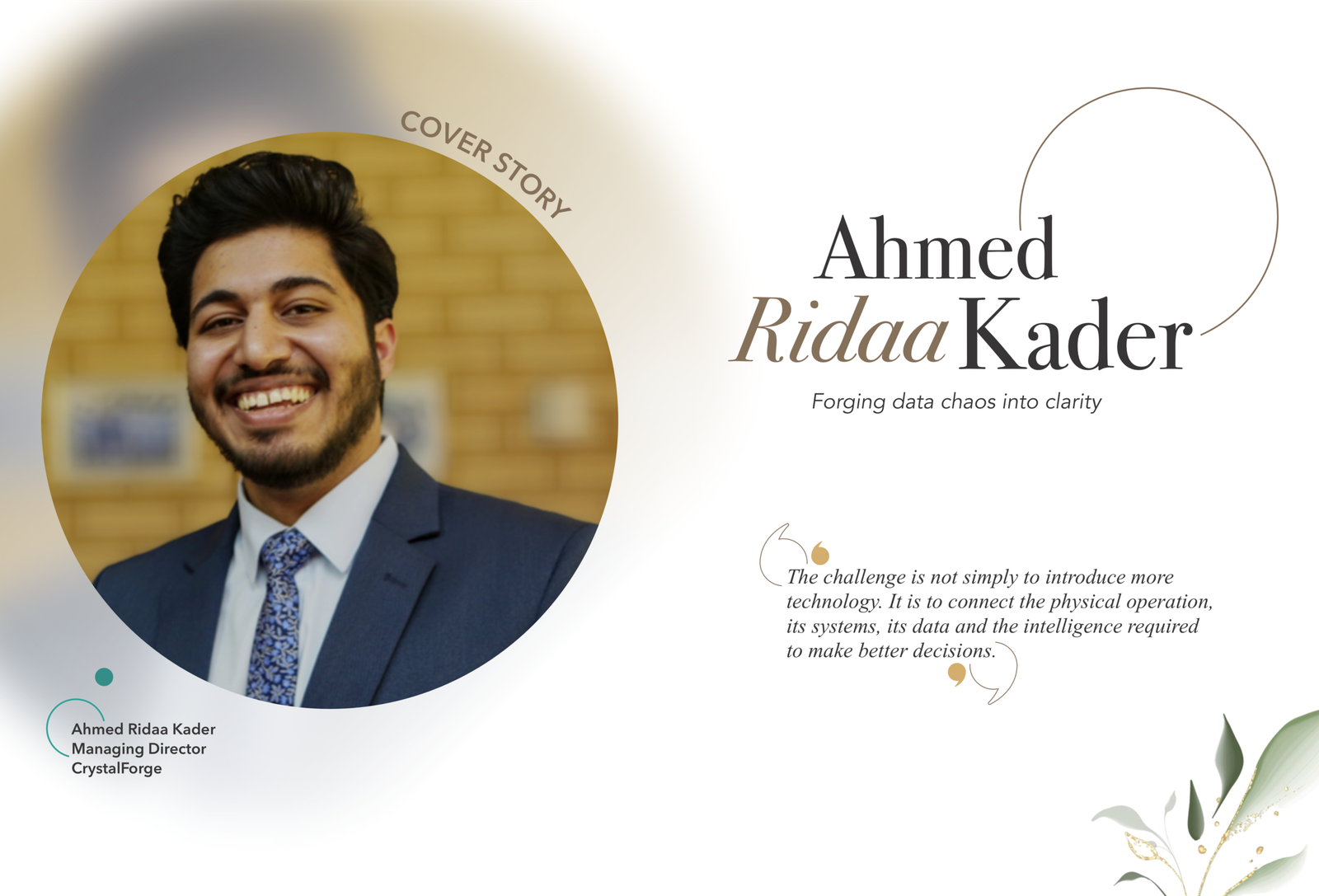
The mightiest industrial machines are not always the smartest. A processing plant can move thousands of tonnes of material, consume enormous amounts of energy and operate with remarkable precision, yet remain unaware of the inefficiencies quietly eroding its performance. Somewhere between the hum of machinery and the endless streams of data lies an extraordinary amount of untapped potential. For decades, engineering has taught industries how to build, produce and scale. Now, a different challenge is emerging: teaching these complex systems to understand themselves.
For Ahmed Ridaa Kader, Managing Director of CrystalForge Technologies, this challenge has become a defining professional pursuit. His journey through Chemical Engineering, metallurgy, industrial operations and digital innovation has given him an unusual perspective on how industries function and where their greatest opportunities remain undiscovered.
Where Engineering Meets Digital Transformation
Ahmed’s professional journey has been shaped by a deep understanding of engineering, industrial operations and the possibilities that emerge when technology is applied to complex processes. With a background in Chemical and Process Engineering, he built his early career within demanding mining and processing environments, including Glencore and Minopex. These experiences gave him firsthand insight into the operational challenges industries face and the opportunities to improve performance through data, modelling and advanced technologies.
At Minopex, Ahmed moved beyond traditional process engineering to establish the company’s digital function from the ground up. As its Head, he created the department, defined its strategic direction, developed its technical capabilities and led the implementation of digital solutions across the business. His work brought together process optimisation, simulation, troubleshooting, data analytics and technology development, translating engineering concepts into practical operational improvements.
His experience at Glencore further strengthened his understanding of the technical, commercial and operational complexities involved in managing industrial operations at scale. Working in environments where engineering decisions must deliver measurable results reinforced his belief that successful innovation requires more than technical sophistication. It must account for real operating conditions, business objectives and implementation constraints.
These experiences ultimately shaped his vision for CrystalForge Technologies. Ahmed sought to build an organisation capable of connecting physical operations, data infrastructure and intelligent decision-making into a unified capability. Equally important to this vision is the team behind it. He believes effective leadership begins with recognising individual strengths, understanding what motivates people and creating an environment where talented professionals can pursue their interests, collaborate and contribute meaningfully to shared goals.
A Multidisciplinary Lens on Industrial Innovation
Ahmed’s experience across Chemical Engineering, metallurgy, data science and business leadership has shaped a problem-solving philosophy that considers industrial challenges from multiple perspectives. His engineering foundation taught him to understand systems, constraints and process behaviour, while his exposure to metallurgy and mineral processing deepened his understanding of how materials and operating conditions influence performance.
His subsequent work in digital technologies and data science expanded the tools available to analyse complex systems, identify patterns and uncover opportunities that might otherwise remain hidden. As his responsibilities grew to encompass business leadership, his focus extended beyond technical feasibility to include implementation, commercial relevance and measurable outcomes.
At CrystalForge Technologies, this combination of disciplines informs how Ahmed approaches innovation. Rather than treating engineering, data and technology as separate functions, he views them as interconnected elements of a larger operational system. Understanding what a business needs to achieve, identifying the constraints preventing progress and engineering a practical solution are, in his view, essential to creating lasting value.
Building Intelligence into the Industrial Core
The vision behind CrystalForge Technologies emerged from Ahmed’s observation that industrial organisations continue to generate increasing volumes of data and invest in sophisticated technologies, yet much of their potential remains disconnected from day-to-day operations.
Fragmented technology environments, legacy infrastructure, multiple vendors and disconnected data sources often prevent organisations from turning available information into timely, actionable insights. Ahmed recognised that addressing this challenge required more than introducing another digital tool. It demanded an integrated capability connecting operational processes, technology infrastructure, data and decision-making.
CrystalForge Technologies was established around this principle. The company focuses on engineering the data infrastructure, integration capabilities and intelligence systems required to translate complex industrial environments into measurable business performance.
For Ahmed, industrial intelligence must be developed with the same rigour as the operations it supports. Technology must reflect the realities of the production environment while serving clear operational and commercial objectives. By connecting previously fragmented systems and information, CrystalForge aims to help organisations identify performance losses, improve decision-making and unlock greater value from their existing operations.
Leadership Beyond the Operational Horizon
Ahmed’s progression from Operations Director to Managing Director has broadened his perspective on organisational growth, strategic direction and leadership. His operational background continues to influence his decisions, grounding business strategy in technical realities, implementation requirements and commercial objectives.
However, his responsibilities now extend to determining where the organisation invests, which opportunities it pursues, what capabilities it develops and the standards it maintains. He sees leadership as the process of creating the direction and conditions that allow an organisation to perform consistently while remaining adaptable.
One of the most important lessons he has drawn from experience is that an organisation’s strength ultimately rests on its people. Ahmed believes that bringing together intelligent, passionate professionals and giving them room to develop their interests encourages innovation, collaboration and professional growth. Leadership, in this sense, is not about possessing every answer but about enabling collective expertise to achieve outcomes that individuals could not accomplish alone.
He also emphasises the importance of maintaining high standards while allowing the organisation to evolve. As industrial technology advances, CrystalForge must remain responsive without compromising its engineering discipline or commercial focus. Ahmed’s long-term ambition is to build a business defined by technical depth, industry relevance and purposeful growth.
Engineering the Next Industrial Shift
Ahmed sees artificial intelligence, advanced analytics and automation as technologies that will substantially reshape mining, metals and manufacturing. However, he believes their greatest impact will depend on how effectively they are integrated into industrial operations rather than on the capabilities of individual technologies in isolation.
Artificial intelligence can help interpret complex operational data and identify patterns, while advanced analytics can provide deeper insights into performance. Automation can improve consistency, reduce repetitive work and enable faster responses to changing operating conditions. When these capabilities are connected through reliable data infrastructure, industrial organisations can move beyond monitoring performance towards anticipating problems and improving outcomes.
In mining and metals, this approach can support processing efficiency, asset performance, energy management, production optimisation and quality control. Manufacturing operations can similarly benefit through improvements in throughput, maintenance, resource utilisation and product quality.
For Ahmed, the competitive advantage will belong to organisations that translate technological potential into measurable improvements. The challenge is not simply to adopt emerging tools but to engineer them into existing operating environments in ways that produce tangible value.
Turning Industrial Data into Decisive Action
Ahmed regards data as a fundamental industrial asset, with its growing scale and complexity creating new opportunities to understand operational performance. At CrystalForge Technologies, this involves connecting information from equipment, control systems, production platforms and enterprise applications, then building the infrastructure needed to manage and interpret it effectively.
The objective is to answer questions that directly influence business performance. Where are production losses occurring? What factors are driving them? How can throughput, recovery, product quality, energy efficiency or asset utilisation be improved? Most importantly, what decisions must change to realise those improvements?
Through data science and advanced analytics, CrystalForge can investigate complex relationships, identify changes in process behaviour and develop models that help organisations understand current conditions and anticipate potential outcomes.
Ahmed’s broader vision is to embed data into the operating model rather than confine it to reporting functions. When information is properly structured, contextualised and accessible to the people responsible for making decisions, it can improve both the speed and quality of those decisions.
Ultimately, his approach reflects a consistent principle that runs through his engineering career and leadership at CrystalForge Technologies: technology creates its greatest value when it is grounded in operational understanding, aligned with business objectives and translated into action.
Making Sustainability a Driver of Industrial Growth
Ahmed believes sustainability and business performance are becoming increasingly interconnected, particularly across industrial sectors where resource efficiency directly influences operational costs and productivity. He sees technology as an important enabler of this relationship, allowing organisations to identify resource consumption patterns, detect losses and understand how their processes behave under real operating conditions.
Through improved data visibility and advanced analytics, businesses can make more informed decisions about energy, water, raw materials, emissions and equipment utilisation. These insights create opportunities to optimise processes, reduce waste and improve reliability while maintaining commercial performance.
For Ahmed, sustainability should not be treated as a separate business objective but incorporated into the design and operation of industrial systems. When technology enables organisations to produce more efficiently while consuming fewer resources, environmental responsibility becomes an integral part of competitiveness. He believes innovation will have its greatest impact when it makes industrial operations more efficient, measurable and sustainable without compromising their commercial objectives.
Addressing the Pressures Reshaping Mining and Metallurgy
Ahmed identifies declining ore grades, increasingly complex processing requirements, rising operating costs and substantial energy and water demands among the major challenges facing the mining and metallurgical industries. These pressures are compounded by increasingly stringent environmental and regulatory expectations, requiring organisations to improve productivity while managing their operational footprint.
He also highlights the difficulties created by legacy infrastructure, fragmented systems and disconnected sources of operational data. Although industrial organisations possess substantial amounts of information, translating it into reliable insights that support everyday decisions remains a significant challenge.
Ahmed believes businesses must adopt an integrated approach that combines deep industry knowledge, robust data infrastructure and engineering expertise. Advanced analytics, automation and intelligent systems can improve recovery rates, throughput, energy efficiency, asset performance and decision-making, but their value depends on identifying the right operational and commercial objectives.
For him, the strongest competitive advantage will come from organisations that continuously learn from their operations, respond effectively to changing conditions and convert insights into practical improvements.
Balancing Today’s Performance with Tomorrow’s Ambitions
Ahmed’s approach to executive leadership centres on maintaining a close understanding of operational realities while making decisions that support long-term business objectives. His engineering background naturally draws his attention to processes, systems, performance and execution, while his responsibilities as Managing Director require him to consider market positioning, organisational capabilities, client requirements and future opportunities.
He places particular importance on distinguishing activity from meaningful progress. Operational improvements are valuable, he believes, when they contribute to a broader organisational objective. Similarly, strategic initiatives must be grounded in practical execution and deliver tangible results.
This perspective shapes his leadership at CrystalForge Technologies, where he seeks to maintain a clear connection between immediate operational improvements and long-term organisational development. By combining technical understanding with commercial judgement, Ahmed aims to strengthen the company’s present performance while building the capabilities required for sustained growth.
Creating a Culture Where Expertise Evolves
Ahmed considers talent development fundamental to building an innovative, high-performing technical organisation. At CrystalForge Technologies, he emphasises the importance of recruiting capable professionals, establishing high standards and creating an environment where individuals are encouraged to think critically, learn continuously and contribute meaningfully.
Because the company’s projects involve multiple areas of expertise, collaboration between engineers, data specialists, software developers and industrial professionals is particularly important. Ahmed believes that bringing these perspectives together enables teams to understand complex challenges more comprehensively and develop solutions that would be difficult to achieve through a single discipline.
Continuous learning is equally important in an industry where technologies and methodologies evolve rapidly. He encourages professionals to strengthen their technical knowledge, explore new approaches and introduce fresh thinking into their work.
Through this emphasis on technical excellence, curiosity, collaboration and accountability, Ahmed aims to develop a culture in which professional growth and high performance reinforce one another.
Experiences That Shaped an Engineering Entrepreneur
Ahmed regards his experiences at Minopex and Glencore as defining influences on his leadership philosophy. At Minopex, establishing a dedicated digital function moved him beyond traditional process engineering and gave him the opportunity to develop technical capabilities, define strategic priorities and lead digital implementation across the organisation.
The experience demonstrated the importance of connecting engineering expertise with digital innovation and practical operational requirements. It also strengthened his understanding of how new capabilities can be developed within established industrial environments.
His time at Glencore provided further exposure to the technical, operational and commercial complexities of large-scale mining and resource operations. Working in this environment reinforced the importance of understanding how engineering decisions affect process performance and how operational constraints shape business outcomes.
Together, these experiences influenced Ahmed’s approach to leadership at CrystalForge Technologies, where engineering discipline, technological capability and commercial relevance remain closely connected.
Engineering the Next Generation of Industrial Intelligence
Ahmed’s vision for CrystalForge Technologies is to establish a globally recognised industrial technology company distinguished by its engineering depth and ability to address complex challenges across asset-intensive industries.
He believes the industrial sector is entering a significant period of transformation, with advances in data processing, computing power and artificial intelligence creating new opportunities to improve operational performance. However, the real opportunity lies in integrating these capabilities effectively with physical processes, industrial infrastructure and decision-making systems.
CrystalForge Technologies aims to operate across this broader industrial technology environment, developing solutions grounded in engineering principles and operational realities. Rather than adopting emerging technologies simply because they are available, Ahmed wants the company to identify where they can deliver meaningful value and translate that potential into practical, scalable systems.
His ambition is for CrystalForge to become recognised for the quality of its engineering, the strength of its technical capabilities and the measurable outcomes it delivers across mining, metals, manufacturing, energy and other asset-intensive sectors.
“The challenge is not simply to introduce more technology. It is to connect the physical operation, its systems, its data and the intelligence required to make better decisions.”
“Leadership is not about having all the answers, but about bringing together people whose collective expertise can achieve far more than any individual.”
“When people are given the freedom to do what they enjoy and excel at, innovation becomes a natural outcome.”