
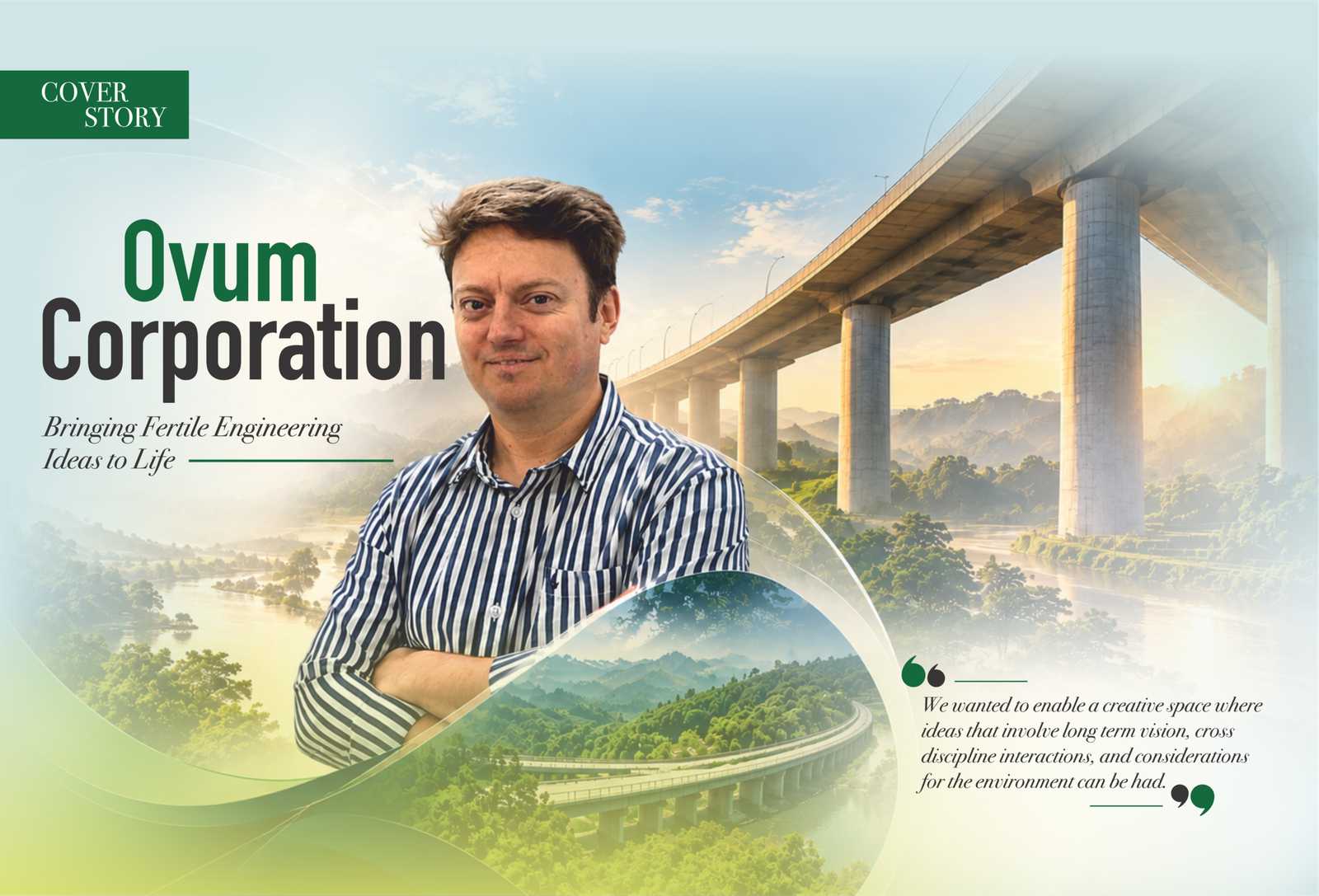
Engineering and fertility are not words that usually appear in the same sentence. One evokes images of calculations, structures, and technical precision. The other belongs to ecosystems, river valleys, and places where life has the ability to regenerate itself. Yet there is an intriguing similarity between the two. The most powerful ideas in engineering are rarely manufactured in isolation. They emerge from observation, adapt to their surroundings, draw strength from diverse influences, and evolve through continuous refinement before taking physical form. Much like a fertile landscape, they possess the capacity to generate possibilities far beyond what was originally imagined. A single idea can become a bridge that transforms mobility, a water system that changes the trajectory of a community, or an infrastructure network that unlocks economic potential for generations.
This philosophy is woven into the identity of Ovum Corporation. Guided by its belief in bringing fertile engineering ideas to life, the organization views every project as an opportunity to cultivate solutions rather than merely deliver them. Its approach combines technical expertise with curiosity, local understanding, environmental awareness, and a willingness to challenge conventional thinking.
The Idea That Challenged the Industry
When Ovum Corporation was established, its leadership recognized several shortcomings within the traditional engineering and consulting landscape. One of the most notable observations was the prevalence of large organizations burdened by extensive overhead structures, often passing unnecessary costs onto clients. The company believed that many clients were being charged for systems and processes that added little value to their projects. Complex project management frameworks, for example, were frequently implemented even when they were not truly requested.
Ovum Corporation saw an opportunity to create a different kind of engineering consultancy, one that emphasized personalized service delivery, specialist expertise, and a more holistic perspective on design and client communication. The organization sought to cultivate a creative environment where long term thinking, interdisciplinary collaboration, and environmental considerations could exist alongside technical excellence. This vision became the foundation upon which the company was built and continues to guide its approach today.
The Local Lens on Global Innovation
A central aspect of Ovum Corporation’s mission is the integration of international best practices into diverse regions around the world. However, the company recognizes that successful implementation requires much more than simply applying global standards in a uniform manner.
Ovum’s philosophy is grounded in the understanding that every region presents unique circumstances, challenges, and limitations. Before entering a new market, the organization dedicates significant effort to understanding the political environment, historical context, social dynamics, and economic realities of the area. Through this process, it identifies both the needs of local communities and the opportunities where meaningful improvements can be made.
Ovum believes that international expertise must be balanced with practical thinking and common sense. By understanding the local landscape and remaining aware of limitations related to infrastructure, service delivery, and regional constraints, Ovum Corporation is able to adapt global engineering principles to create solutions that are both effective and relevant.
Engineering in Harmony with Nature
Ovum Corporation’s understanding of sustainability has evolved considerably over time. In its early years, sustainability was often viewed through a relatively straightforward lens. Exposure to innovative urban environments such as those found in Singapore, where buildings are integrated with abundant greenery and vegetation, initially shaped perceptions about what sustainable development could look like.
As the company’s experience expanded, so too did its understanding of the complexity involved in creating truly sustainable solutions. It became increasingly apparent that sustainability extends far beyond visual elements and requires consideration of numerous interconnected factors, including material sourcing, lifecycle impacts, the unpacking of hidden environmental consequences, and long term resource management.
The design of bridges provides a useful illustration of this philosophy. A bridge functions as a connector between places that were previously isolated from one another. From a sustainability perspective, a bridge that enables efficient transportation across a vast gorge can significantly reduce travel times, fuel consumption, and resource use compared to lengthy alternative routes.
However, the company acknowledges that not all sustainability decisions are so clear cut. True sustainability, in its view, requires solutions that do not deplete the environment in harmful ways over the long term and ideally contribute to the replenishment of natural resources. Achieving this standard is often challenging in practice.
Ovum Corporation also recognizes that discussions around sustainability can sometimes overlook the full environmental costs associated with infrastructure projects. Whether considering buildings, dams, wind turbines, or other developments, responsible engineering requires a comprehensive understanding of environmental impacts. For the company, a genuinely sustainable solution is one that thoughtfully addresses every aspect of its interaction with the natural environment.
Lessons from Diverse Engineering Landscapes
Operating across multiple countries and varied environments has reinforced the belief that there is no universal formula for success. Ovum Corporation views adaptability as one of the most important attributes in engineering and project delivery.
The company believes that survivability in challenging conditions depends largely on the ability to adapt to unfamiliar situations. This flexibility often determines whether a project succeeds or encounters significant obstacles.
Among the most valuable lessons learned has been the importance of understanding local constraints before making design decisions. Every environment presents unique technical, regulatory, logistical, and cultural considerations that must be acknowledged and incorporated into project planning.
Another critical lesson has been the importance of stakeholder engagement. In unfamiliar settings, ensuring that all relevant parties are consulted is essential. Failure to involve the appropriate stakeholders can create unnecessary complications and place projects at risk. Through experience, Ovum Corporation has come to view inclusive consultation as a fundamental component of successful project execution.
The Digital Transformation of Engineering
Modern software platforms now incorporate artificial intelligence functionalities alongside advanced three-dimensional visualization tools. At Ovum Corporation, these technologies have been integrated into engineering workflows to enhance project planning, coordination, and delivery. By leveraging digital tools, the company is able to improve design accuracy, facilitate clash detection, streamline multidisciplinary collaboration, and provide clients with greater transparency throughout the project lifecycle. These capabilities enable Ovum to deliver more efficient, data-driven, and responsive engineering solutions while adapting to the evolving demands of the industry.
For Ovum, the expanding range of digital tools has made the profession more dynamic and exciting than ever before. The availability of sophisticated technologies has also accelerated knowledge transfer between disciplines, creating new opportunities for collaboration and innovation.
Client expectations have evolved alongside these technological advancements. Today’s clients often expect faster delivery times, higher levels of quality, and greater transparency throughout the design process. As a result, Ovum’s project planning must account for these heightened expectations from the outset.
Visualization has become an essential component of modern engineering practice. Fly through presentations and advanced digital representations are now integrated into virtually every project, helping clients better understand design concepts while supporting more informed decision making throughout the development process.
Strength Through Multidisciplinary Thinking
While Ovum Corporation maintains a primary focus on civil and structural engineering, it also offers expertise across hydraulic, chemical, and process engineering disciplines.
The organization believes that multidisciplinary collaboration strengthens project outcomes by enabling broader perspectives during planning and execution. Continuous communication and brainstorming among specialists create opportunities to identify solutions that may not emerge within a single discipline.
This integrated approach enhances project quality in several ways. Risks can often be identified earlier, coordination between disciplines becomes more effective, and potential conflicts can be resolved before they affect project delivery. The result is a more comprehensive and resilient solution that serves both client objectives and project requirements more effectively.
The Delicate Equation of Progress
Balancing environmental responsibility, commercial viability, and community needs is one of the most common challenges encountered in infrastructure development.
Ovum Corporation recognizes that this dilemma extends far beyond the construction industry and reflects broader tensions present throughout society. Examples such as deforestation in the Amazon, the development of new mining operations, and the over exploitation of marine resources illustrate the difficult trade offs that often arise between economic growth and environmental preservation.
While such activities may generate employment and economic opportunities, they can also impose significant environmental costs that require decades to recover from, if recovery is possible at all.
The company believes that responsible development begins with careful stewardship of available resources. Every project should be approached with a commitment to minimizing environmental harm while honestly evaluating whether the long term consequences outweigh the perceived short term benefits. This perspective guides the organization’s approach to creating value for clients while remaining accountable to society and the environment.
The Search for Sustainable Power at Scale
Ovum Corporation’s views on the future of energy have evolved significantly over time. While renewable technologies such as wind and solar power were once viewed as the primary solution to global energy challenges, the company now adopts a more nuanced perspective.
Wind energy faces challenges related to variability, while solar power remains dependent on daylight conditions. Although both technologies have important roles to play, particularly in remote regions of sub-Saharan Africa, they are unlikely to meet future demand on their own.
Global electricity consumption is expected to increase dramatically by 2050, driven by a near threefold rise in demand from artificial intelligence, data centres, electric vehicles, industrial electrification, heat pumps, and population growth. Much of this demand is anticipated to originate within the Asia Pacific region.
However, this same region also faces heightened exposure to natural disasters, posing a significant risk in the form of earthquakes, tsunamis, and volcanic activity, which create additional complexities for infrastructure design and delivery.
Looking ahead, Ovum Corporation believes that advanced technologies such as fusion energy and nuclear power generation may become increasingly important in addressing future energy requirements. While fusion remains in its early stages of development, both technologies offer the potential to support the large-scale, reliable energy production that future societies may require. In the not-too-distant future, small-scale modular nuclear reactors could become more widely adopted for localised power generation, providing dependable energy with relatively limited operational intervention and periodic maintenance requirements.
Collaboration as the Foundation of Success
For Ovum Corporation, successful collaboration begins with presence, commitment, and engagement.
The company believes that building strong partnerships requires a genuine understanding of clients and their objectives. It is not enough to provide technical expertise alone. Effective collaboration involves showing up, participating actively, and contributing practical solutions throughout the project lifecycle.
Listening also plays a crucial role. By understanding the perspectives of architects, contractors, clients, and other stakeholders, engineers can arrive at solutions that are technically sound while addressing broader project goals.
Ultimately, Ovum views collaboration as an extension of communication. Strong relationships are built through ongoing dialogue, mutual respect, and a shared vision of the project, and a shared commitment to achieving successful outcomes.
Unlocking Africa’s Infrastructure Potential
Looking toward the next decade, Ovum Corporation sees tremendous opportunities for unlocking infrastructure investment and innovation throughout Africa.
Among the most significant areas of opportunity are water supply systems, transportation networks, roads, bridges, and electrical infrastructure. These sectors are expected to play a central role in supporting economic development and improving quality of life across the continent.
The company believes that Africa possesses enormous potential for growth, yet progress is often constrained by limited long term vision and insufficient political commitment. Many regions continue to face urgent infrastructure deficits that hinder economic activity and social advancement.
Addressing these challenges will require sustained investment, strategic planning, and a willingness to pursue transformative development initiatives capable of unlocking the continent’s full potential.
Building a Landmark for the Democratic Republic of the Congo
Among Ovum Corporation’s current projects, one stands out as a particularly powerful reflection of its mission to bring fertile engineering ideas to life.
The company is involved in the design and delivery of major bridge infrastructure in the city of Kisangani within the Democratic Republic of Congo. The project emerged after the client had explored several previous concepts that proved impractical given the unique constraints of the site.
The challenge involved constructing a bridge approximately 200 metres long, with a central span of 90 metres, situated above the fast-flowing Tshopo River, a scenario requiring innovative engineering solutions. Through extensive technical analysis and design refinement, Ovum Corporation developed an approach capable of addressing the project’s complex environmental and structural requirements.
Once completed, the bridge is expected to become the first structure of its kind within the Democratic Republic of the Congo. Beyond its technical significance, the project embodies the organization’s commitment to practical innovation and transformative infrastructure development.
A Legacy Rooted in Excellence and Nature
As Ovum Corporation continues with its international operations, its long term vision moves far beyond engineering in the conventional sense.
Its wish is to encourage more interaction between engineering and other sciences like environmental science, biology, and even the arts. In doing this, the company aims to innovate not just technologically but also to be nature friendly.
The legacy that Ovum Corporation wants to leave behind involves engineering excellence, open-mindedness, and harmony with nature. Such a perspective is based on the idea that the earth has some unique characteristics which call for the need to ensure that its future is well taken care of.
Ovum Corporation believes that engineering is the way to move humanity forward through innovation. Although we do share the vision of humanity becoming an interplanetary species in the future, our focus at present is on applying what we know from both human ingenuity and the natural world to better serve our remarkable planet, Earth.
Through its projects, partnerships, and vision, Ovum Corporation continues to pursue a future where advanced engineering solutions contribute meaningfully to both human progress and environmental stewardship.
Featuring Personality: Nicholas Featherston
Organization: Ovum Corporation
“We wanted to enable a creative space where ideas that involve long term vision, cross discipline interactions, and considerations for the environment can be had.”
“A truly responsible and sustainable solution is one that adequately addresses all aspects of the impact of the solution on the environment.”
“Our multidisciplinary approach means that a more holistic solution can be arrived at through constant brainstorming and communication.”