
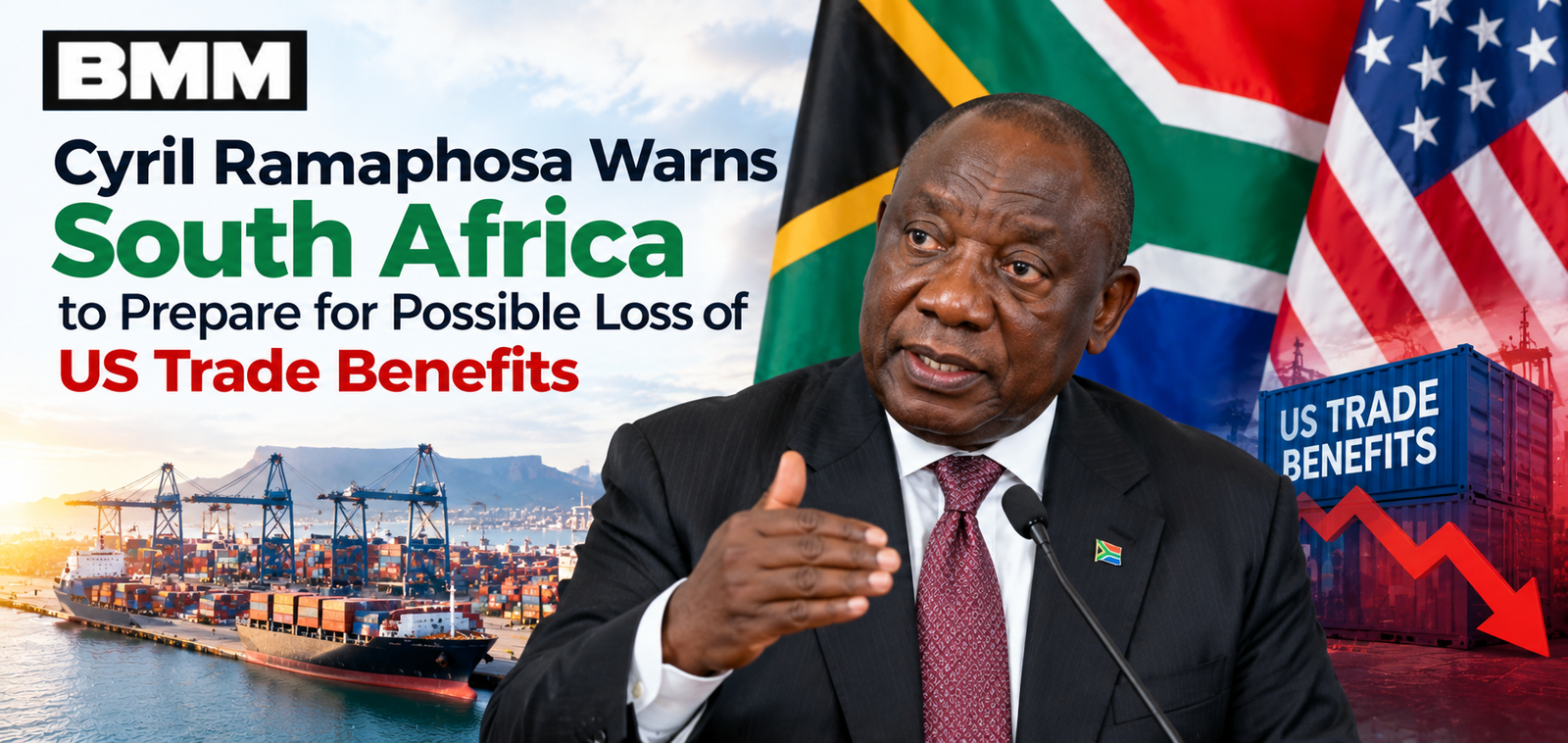
South African President Cyril Ramaphosa has warned that the country must prepare for the possibility of losing preferential access to the United States market under a major African trade programme, as diplomatic and economic tensions between Washington and Pretoria continue. Ramaphosa said his government was exploring alternative export destinations to limit the potential damage, while acknowledging that exclusion could have serious consequences for employment and industry.
The warning has renewed attention on the South Africa AGOA trade deal, which has provided eligible African economies with preferential access to the American market for thousands of products. Although the programme has received legislative approval for an extension through 2028, uncertainty remains over South Africa’s continued eligibility and the next steps required for the extension to take effect.
Ramaphosa Calls for Preparation Amid Trade Uncertainty
When speaking on Monday, October 19, Ramaphosa said that South Africa cannot afford to take for granted its involvement in the programme for a long time into the future. He also stated that talks with their American counterparts are still in progress, but the threat of exclusion necessitated preparation for another scenario.
According to Ramaphosa, the loss of AGOA deal benefits will have a very devastating impact, especially on the job market that is related to export industries. However, he asked his fellow citizens not to get nervous because the government is actively searching for new markets to export products to.
President Ramaphosa, together with Deputy President Paul Mashatile, has been talking with foreign partners about expanding trading ties. This approach helps to minimize dependence on one trading partner and become less vulnerable to changes in American policy on trade.
What Is AGOA and Why Does It Matter?
AGOA is the name for the African Growth and Opportunity Act, which permits qualifying sub-Saharan African nations to enter into trade with the US without being required to pay specific import tariffs on up to thousands of products. The aim of this initiative is to promote business, foster economic growth and build relations between the US and African economies.
Being the largest beneficiary of this programme, South Africa’s continued membership is crucial. Preferential trade makes the exporting industry more competitive and helps businesses which require foreign demand to survive.
Trade agreement between South Africa and AGOA is of great significance to the automotive industry since cars produced in South Africa are exported to the USA. Stable trading environment is necessary to ensure proper manufacturing, investment and employment in this industry.
As per an estimate provided by Reuters and AFP, about 86,000 jobs in the manufacturing of cars are connected to this agreement, while including the subcontracting companies the number reaches about 125,000.
Strained Relations With Washington
This uncertainty regarding AGOA comes as relations between the two nations continue to deteriorate. The Trump Administration has criticized the leadership in Pretoria on a number of political and internal policy grounds. One of those has been the treatment of the white minority in South Africa. The South African government, on its part, denies allegations of any such discrimination against the white community.
There are American policymakers who believe that South Africa should be excluded from the program. But according to Ramaphosa, this is uncertain at the moment, and negotiations are still ongoing.
In effect, the future of the South Africa AGOA Trade deal is no longer based on commercial issues alone. Instead, it has become an issue of foreign relations as well. For Pretoria, continued access to the US markets is important while waiting for the results of negotiations.
South Africa Looks Beyond the US Market
Uncertainty has led the government to seek ways of increasing trade between South Africa and other big economies, including China and India. Ramaphosa indicated that China’s move to provide zero tariffs to eligible South African products was a good sign.
The South Africa AGOA trade deal uncertainty has further increased the need to diversify into other export markets, although this can be done over time. Other markets also have their respective regulations, consumer tastes and logistics, and hence it will be hard to find a replacement of business from America overnight.
In this regard, the strategy being pursued by South Africa involves maintaining the current commercial relations while at the same time creating new ones.
What Happens Next?
The first step to consider is whether South Africa would maintain its favorable access under the AGOA program through the extension process. As reported on October 19 and 20, 2026, the U.S. Congress passed an extension through the end of 2028, but it has not yet received a signature from President Trump.
The South Africa AGOA trade deal has been of considerable importance to policymakers and companies because an exclusion could negatively affect their export prices.
At present, President Ramaphosa’s administration seeks to achieve two goals simultaneously: establishing relations with the White House and considering alternatives in the case of trade benefits withdrawal. In turn, it is important not only for the exporters but also for the citizens whose livelihoods depend on foreign trade relations.
The South Africa AGOA trade deal controversy reveals the potential risks that can be imposed on the economy in case of the connection between diplomatic problems and trade access issues.