
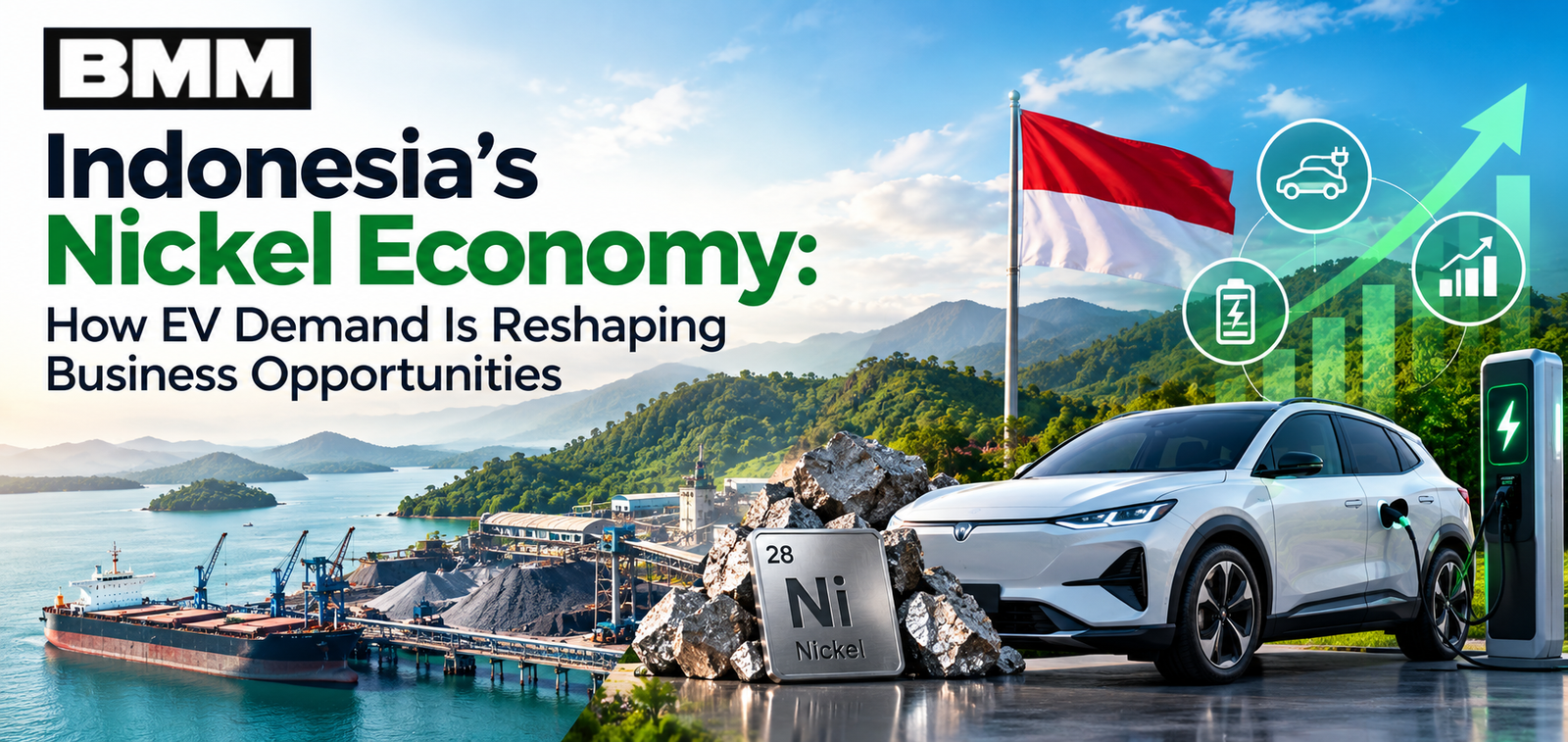
The global transition toward electric mobility is transforming industries, supply chains, and investment priorities around the world. As governments and businesses accelerate efforts to reduce carbon emissions, demand for electric vehicles (EVs) continues to rise at an unprecedented pace. At the center of this transformation is a critical raw material that powers many EV batteries: nickel.
Indonesia, home to some of the world’s largest nickel reserves, has emerged as a major player in the global energy transition. The growth of the Indonesia nickel economy is not only strengthening the country’s position in international supply chains but also creating a wide range of new business opportunities across mining, manufacturing, technology, logistics, and infrastructure.
As global automakers and battery manufacturers seek secure access to essential materials, Indonesia is rapidly evolving from a resource exporter into a strategic hub for EV production and innovation.
The Growing Importance of Nickel in the EV Revolution
Nickel is an essential component in the manufacture of lithium-ion batteries in electric vehicles. Nickel-based batteries have high energy density and deliver more miles per kilowatt-hour, hence increased performance levels, thus making nickel one of the valuable commodities. Due to the rising demand for nickel from the increasing use of electric vehicles across the globe, the value of the Indonesia nickel industry has increased immensely.
Indonesia is aware of the potential of nickel; hence, its policies to derive maximum value from it domestically instead of exporting it as raw materials.
Indonesia’s Strategic Shift From Exporter to Industrial Powerhouse
In the past, Indonesia exported huge amounts of raw nickel ore to the international market. Nevertheless, the government became aware that there was an opportunity cost associated with exporting primary products.
In order to promote industrial activities, the government has introduced restrictions on the export of raw materials along with various incentives. This strategy was expected to facilitate the establishment of smelters, refining plants, and industrial estates in Indonesia.
This kind of industrial strategy has become a key aspect of the Indonesia nickel industry and helps in forming an industrial system. Through the processing of nickel domestically, Indonesia is able to increase value through the utilization of its natural resources.
The Rise of the Indonesian EV Battery Industry
One of the important results of this strategy in the industrial sector is the swift growth of the Indonesian EV battery industry.
Foreign battery and car firms are increasingly setting up operations in Indonesia to ensure a dependable supply of nickel and to create regional manufacturing units. Through partnerships between foreign firms and domestic firms, a complete battery value chain from mining to car manufacturing is being developed.
The development of the battery manufacturing plants is giving rise to opportunities for suppliers, technology providers, engineering firms, and infrastructure developers.
With the increased demand for EV batteries, Indonesia is becoming a major destination for global battery manufacturing and innovations.
Investment Flows Continue to Accelerate
The growth of the EV sector has triggered substantial levels of Indonesia nickel investment from both domestic and international sources.
Major investments have been directed toward:
- Nickel mining operations
- Smelting and refining facilities
- Battery material processing plants
- Industrial parks
- Renewable energy infrastructure
- Logistics and transportation networks
These investments have brought about major changes in whole regions, especially those that abound with nickel deposits. Manufacturing sites which had concentrated only on mining are being converted to advanced industrial sites geared toward manufacturing electric vehicles for the international market.
The inflow of investments is also fostering the growth of complementary industries.
How Indonesia’s Nickel Economy Is Creating EV Business Opportunities
The question of How Indonesia’s nickel economy is creating EV business opportunities can be answered by examining the diverse ecosystem emerging around the industry.
Production of Batteries
As the capacity for battery production increases, there are more opportunities that will arise for companies dealing with battery materials, battery cell production, testing, quality control, and recycling technology.
Companies that can assist with the processes of battery production are increasingly becoming demanded by both local and international battery manufacturers.
Industrial Infrastructure
The fast-growing supply chain of electric vehicles necessitates massive amounts of industrial infrastructure.
Firms in construction, engineering, utilities, and industrial parks are enjoying the increase in the demand for factories, processing plants, road networks, ports, and power supply systems.
Such projects create jobs and economic value for the communities that are adjacent to them.
Technology and Automation
With the modern methods of nickel processing and battery manufacturing, there is an increased reliance on automation and technology.
Technology providers of software, industrial automation, artificial intelligence, cybersecurity, and monitoring services are increasingly finding opportunities in this industrial ecosystem.
Logistics and Supply Chain Management Services
Efficient logistics services are essential in order to move raw materials, nickel-based products, battery parts, and finished products.
Freight services, warehouse managers, transportation companies, and supply chain management firms have experienced the benefits associated with industrial growth in the Indonesia electric vehicle industry.
Renewable Energy Development
There are many companies operating in the EV supply chain who seek sustainable energy sources.
This has led to opportunities for renewable energy companies developing solar power, hydroelectric, and other sources of sustainable energy.
Opportunities for Local Businesses and Entrepreneurs
The rise of the Indonesia nickel economy does not only benefit multinational corporations.
Smaller enterprises have the chance to be involved in supply chain operations through offering services such as equipment maintenance, labor training, environmental consulting, transport, catering, security, and business assistance.
There are also entrepreneurs coming up with creative innovations involving recycling, sustainability, industrial services, and labor development.
As more industrial clusters arise, these local businesses have a chance of tapping into a larger pool of customers and partnerships.
Challenges Facing the Industry
Despite all its strengths, there are some issues that need to be overcome in order for the industry to sustain growth.
Environmental issues are one of the major concerns. It is important to manage the processes of nickel mining and extraction in order not to have negative effects on the environment.
The need for infrastructure is constantly growing. The process of industrialization leads to the need for better transportation systems, electricity production capabilities, and water supply.
One of the issues is that of personnel development. As the Indonesia EV battery industry develops, the industry needs more professionals in engineering, technologies, manufacturing, and environmental management.
The Future of Indonesia’s EV Ecosystem
The future of the Indonesia electric vehicle industry appears increasingly promising as global demand for EVs continues to expand.
A great number of experts consider Indonesia to have the capacity to turn into one of the key global centers for the manufacture of EVs and battery production.
The future steps for the further development could involve a larger share of attention to the issues of battery recycling, EV assembling, renewables and technology advancement.
In case this tendency goes on, the country could turn from being a leader in the production of nickel into being a complete ecosystem for EVs.
Conclusion
The rise of the Indonesia nickel economy demonstrates how natural resources can serve as a foundation for broader industrial transformation. By moving beyond raw material exports and investing in downstream industries, Indonesia is creating a powerful platform for economic growth and technological advancement.
The expansion of the Indonesian nickel industry, increasing Indonesia nickel investment, and rapid development of the Indonesia EV battery industry are generating opportunities across manufacturing, infrastructure, logistics, technology, and entrepreneurship.
As the global appetite for electric cars grows, Indonesia is perfectly poised to become an integral player in the future of sustainable transport. Nickel, one of Indonesia’s greatest natural reserves, is not anymore only a raw material but also a strategic resource that marks a new era of industrial growth.
FAQ
1. Why is Indonesia important to the global nickel economy?
Indonesia is a major global nickel producer, making it an important supplier of raw materials used in stainless steel and electric vehicle batteries. Its nickel reserves and growing processing industry support its ambition to become a key player in the global EV supply chain.
2. How is EV demand reshaping Indonesia’s nickel industry?
Rising demand for electric vehicles is increasing interest in nickel used in certain EV battery chemistries. This is encouraging investment in nickel processing, battery materials, refining, and related industrial infrastructure.
3. What business opportunities are emerging from Indonesia’s nickel economy?
Key opportunities include nickel mining, mineral processing, battery-material manufacturing, recycling, logistics, industrial technology, renewable energy, and environmental management services.
4. Why is Indonesia attracting investment in nickel processing and battery production?
Indonesia is seeking to capture more value from its mineral resources by encouraging domestic processing and developing an integrated EV battery supply chain. Its resource base and industrial policies can attract investors seeking opportunities beyond raw-material exports.
5. How does nickel contribute to electric vehicle battery production?
Nickel is used in several lithium-ion battery chemistries, including nickel-rich NMC (nickel manganese cobalt) batteries, where it helps increase energy density. However, not all EV batteries require nickel; lithium iron phosphate (LFP) batteries are a major nickel-free alternative.
6. What are the biggest risks facing Indonesia’s nickel industry?
Major risks include fluctuating nickel prices, global oversupply, changing battery technologies, environmental concerns, regulatory uncertainty, and competition from alternative battery materials. Businesses must assess market conditions and long-term demand before investing.
7. How can small and medium-sized businesses benefit from Indonesia’s nickel boom?
Small and medium-sized businesses can explore opportunities in industrial equipment maintenance, transportation, warehousing, worker training, waste management, engineering, and digital services for mining and processing companies.
8. What role does government policy play in Indonesia’s nickel economy?
Government policies promoting domestic mineral processing and downstream manufacturing aim to increase the value generated within Indonesia. These initiatives can encourage investment in refining, battery materials, and EV-related industries, although regulatory changes remain an important consideration.
9. How can Indonesia make nickel production more sustainable?
Indonesia can improve sustainability by expanding renewable energy use in processing facilities, strengthening environmental monitoring, reducing mining waste, rehabilitating mined land, improving supply-chain transparency, and enforcing responsible labor practices.
10. Will the growth of EVs guarantee long-term demand for Indonesian nickel?
No. EV adoption may support demand for nickel-based batteries, but growth is not guaranteed. The increasing use of nickel-free LFP batteries, changes in battery technology, and global supply conditions could affect future demand and prices. Diversifying into stainless steel, battery recycling, and other value-added products can help reduce market risks.