
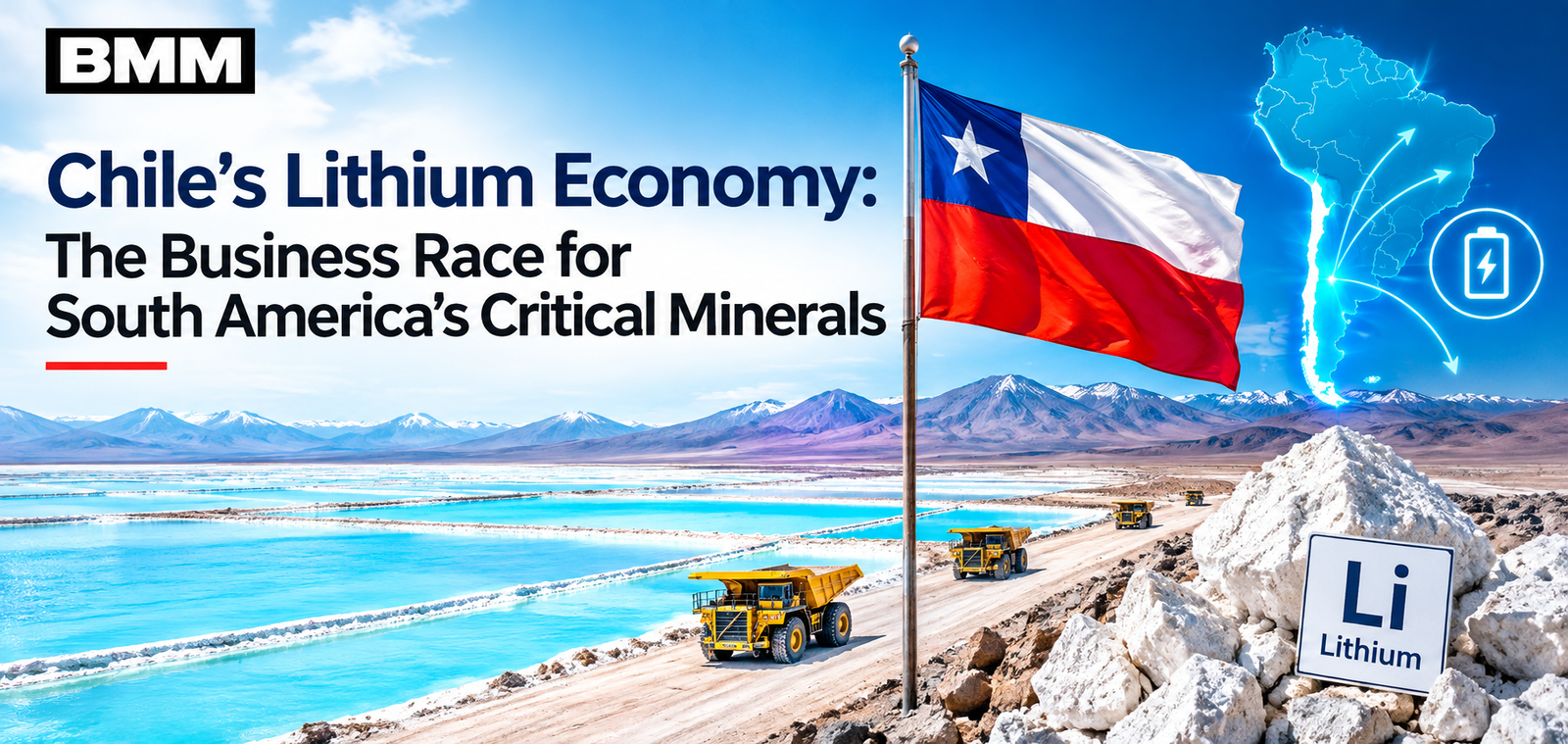
As the global transition toward clean energy accelerates, the demand for critical minerals has become one of the defining economic trends of the 21st century. Governments, automakers, battery manufacturers, and technology companies are all competing to secure reliable supplies of the raw materials needed to power electric vehicles (EVs), renewable energy storage systems, and advanced technologies.
Among these resources, lithium has emerged as one of the most strategically important. Often referred to as “white gold,” lithium is an essential component in the rechargeable batteries that power modern electric vehicles. As a result, countries with substantial lithium reserves have become increasingly influential within global supply chains.
At the center of this transformation is the Chile lithium industry, which has positioned the country as one of the world’s leading producers of lithium. With vast reserves located in the Atacama Desert and growing international demand, Chile is playing a crucial role in shaping the future of clean energy and electric mobility.
Why Lithium Matters in the Energy Transition
Lithium is an integral component of lithium-ion batteries that are commonly used for the powering of electric vehicles, consumer devices, and energy storage systems. With the increasing interest in decarbonization by states and the adoption of EVs by people, lithium consumption will only grow even more in the years ahead.
Experts estimate that the global consumption of lithium can increase manifold within decades. Such a trend promotes the development of the mining industry and the production of batteries while increasing the strategic significance of states that produce lithium.
The development of Chile lithium economy is no exception. As lithium becomes more valuable for the transition to green energy, Chile’s minerals attract the attention of international investors and manufacturers.
Advantages of Chile in the Global Lithium Industry
The country has the largest and best-quality reserves of lithium in the world. Most of the lithium produced by Chile comes from Salar de Atacama – one of the richest lithium brines in the world.
Several advantages make Chile an attractive state for the lithium industry:
Abundant Reserves of Lithium
This fact provides long-term prospects for the development of the industry both at home and internationally.
High-Quality Deposits
Lithium extracted from Chilean brine deposits is often considered highly competitive due to favorable concentration levels and extraction conditions.
Established Mining Expertise
Chile boasts years of experience in mining and resource exploration, with well-developed infrastructure, expertise, and regulatory frameworks to back them up.
It is because of this that the Chile lithium industry serves as a key supplier to the battery and automobile industries around the world.
The Growth of Chile’s Lithium Economy
The rapid expansion of electric mobility is driving significant growth throughout the Chile lithium economy.
The mining companies are expanding their capacities to fulfill the growing demand worldwide. The government is looking for methods to create more value domestically by making investments that go beyond extracting the mineral.
Previously, most of the value created from lithium was being created outside the producing countries via refinement, battery production, and technology. Now, Chile wants to find a way to participate in those more value-added activities.
It opens up possibilities for the firms working in these spheres.
The Evolution of Chile Lithium Mining
The success story of the industry starts with the Chile lithium mining industry which forms the basis of the lithium economy in Chile.
There is a lot of investment in innovative mining technology that aims at increasing efficiency and solving environmental issues. There are innovations in the areas of water usage, resources recovery and sustainable mining which have become particularly important in the light of increased attention to responsible mining worldwide.
The industry is also creating jobs, boosting the local economy, and attracting foreign investments.
With continued growth in demand for battery materials, Chilean lithium mining industry will continue to be an economic engine for exports.
Rising Global Interest and Investment
The competition worldwide for critical minerals is causing significant lithium investment in Chile.
Mining companies globally, battery manufacturers, automobile companies, and financial institutions are spending billions of dollars on projects focused on securing and improving the lithium value chain. The investments involve:
- Mining exploration
- Increasing production capacity
- Facilities processing
- Research and development
- Infrastructure development
- Sustainability
The lithium investment in Chile shows increased faith in the country’s importance in the global energy transformation process.
Investors understand that the availability of lithium will be crucial for meeting future EV manufacturing and renewable energy technologies requirements.
Chile Lithium Industry and Its Role in the Global EV Supply Chain
Understanding the Chile lithium industry and its role in the global EV supply chain requires examining how lithium moves from extraction to finished products.
The process starts with the extraction of lithium from the mines in Chile. Lithium is then processed to produce compounds used by various manufacturers around the world for batteries.
Manufacturers of electric cars rely on consistent availability of lithium as their demand increases. With the increasing adoption of electric cars in North America, Europe, and Asia, the importance of Chile in these chains is further emphasized.
The ability of the Chile lithium industry to provide reliable and scalable production supports global efforts to transition toward cleaner transportation solutions.
Areas Outside of Mining
Although mining forms the bedrock of the industry, several other business areas continue to emerge in the wider lithium ecosystem.
Processing and Refining
Local processing will enable Chile to benefit more from its raw materials and also strengthen its place in global supply chains.
Technology and Innovation
Specialized firms in battery technologies, resource efficiency, automation, and environmental monitoring have found increasing opportunities in the industry.
Logistics and Infrastructure
Logistics services are required for the transport of lithium products and are part of a larger infrastructure network.
Renewable Energy Usage
There is an increasing push by mining and processing plants towards renewable energy to cut down on their carbon footprints.
The Strategic Importance of South America’s Critical Minerals
The energy revolution around the world has increased the significance of critical minerals in South America.
Chile, Argentina, and Bolivia comprise what is referred to as the “Lithium Triangle” in South America, where a significant number of the world’s known deposits of lithium can be found.
Due to the increasing need for strategic materials, the significance of South America critical minerals within the world’s supply chains is likely to increase in future years.
Due to the expansion of electric cars, battery storage systems, and renewable energy technology, there will be an increasing demand for critical minerals from South America.
Challenges and Sustainability Considerations
Despite its advantageous standing, however, the industry is facing a number of difficulties.
One of the main challenges is that of water management, especially when it comes to areas that lack water and thus where lithium extraction takes place.
Another challenge that is becoming more and more relevant is that of environmental protection and proper development of resources. There is also growing competition on the global market.
Conclusion
The Chile lithium industry has become one of the most important pillars of the global clean energy transition. As electric vehicle adoption accelerates and battery demand continues to grow, Chile’s vast lithium resources are positioning the country as a strategic leader within international supply chains.
The expansion of the Chilean lithium economy, advancements in Chilean lithium mining, and rising lithium investment are creating opportunities that extend far beyond resource extraction. From processing and technology to infrastructure and sustainability, a broad ecosystem of businesses is emerging around this rapidly growing sector.
As demand for South America critical minerals continues to rise, Chile’s influence within the global EV market is expected to strengthen further. The country’s ability to balance resource development, environmental responsibility, and industrial growth will play a crucial role in determining how successfully it capitalizes on one of the most significant economic opportunities of the modern energy era.
FAQ
1. Why is Chile important to the global lithium industry?
Chile is an important lithium-producing country with significant resources and established mining expertise. Lithium is essential for rechargeable batteries used in electric vehicles and energy storage systems. <Cite refs={[“turn799246search0″,”turn799246search14”]}/>
2. What is lithium used for?
Lithium is primarily used in rechargeable batteries for electric vehicles, smartphones, laptops, and energy storage systems that support renewable energy.
3. Where is lithium extracted in Chile?
A major lithium-producing area is the Salar de Atacama, a salt flat in northern Chile. The region is central to the country’s lithium industry. <Cite refs={[“turn799246search14”]}/>
4. Why are global businesses interested in Chile’s lithium?
Businesses are interested in Chile because lithium is a key material for battery production and clean-energy technologies. Investment opportunities include extraction, processing, technology development, and partnerships with Chilean entities. <Cite refs={[“turn799246search0″,”turn799246search5”]}/>
5. What is Chile’s National Lithium Strategy?
Chile’s National Lithium Strategy aims to expand the industry, encourage public-private partnerships, attract technology and investment, and promote environmentally and socially responsible development. <Cite refs={[“turn799246search0″,”turn799246search3”]}/>
6. How does the Chilean government participate in lithium production?
The government aims to maintain a leading role in the lithium industry while working with private companies. The strategy includes state participation in strategic projects and partnerships to develop production and processing. <Cite refs={[“turn799246search3″,”turn799246search6”]}/>
7. How does lithium support the clean energy transition?
Lithium is a key component of many rechargeable batteries. These batteries power electric vehicles and help store electricity generated by renewable sources such as solar and wind energy.
8. What environmental challenges are associated with lithium mining in Chile?
Lithium extraction in salt-flat environments raises concerns about water resources, ecosystem protection, and impacts on local communities. Responsible water management, environmental monitoring, and lower-impact technologies are important considerations. <Cite refs={[“turn799246search0″,”turn799246search7”]}/>
9. What business opportunities exist in Chile’s lithium sector?
Potential opportunities include lithium extraction, refining, battery materials, research and development, extraction technologies, and partnerships across the battery supply chain. The scale of each opportunity depends on regulations, investment conditions, and project development. <Cite refs={[“turn799246search5″,”turn799246search14”]}/>
10. What is the future outlook for Chile’s lithium economy?
Chile’s outlook depends on global battery demand, lithium prices, investment, production growth, environmental safeguards, and its ability to develop more value-added industries. Its National Lithium Strategy seeks to support sustainable growth and strengthen Chile’s role in global supply chains. <Cite refs={[“turn799246search0″,”turn799246search11”]}/>