
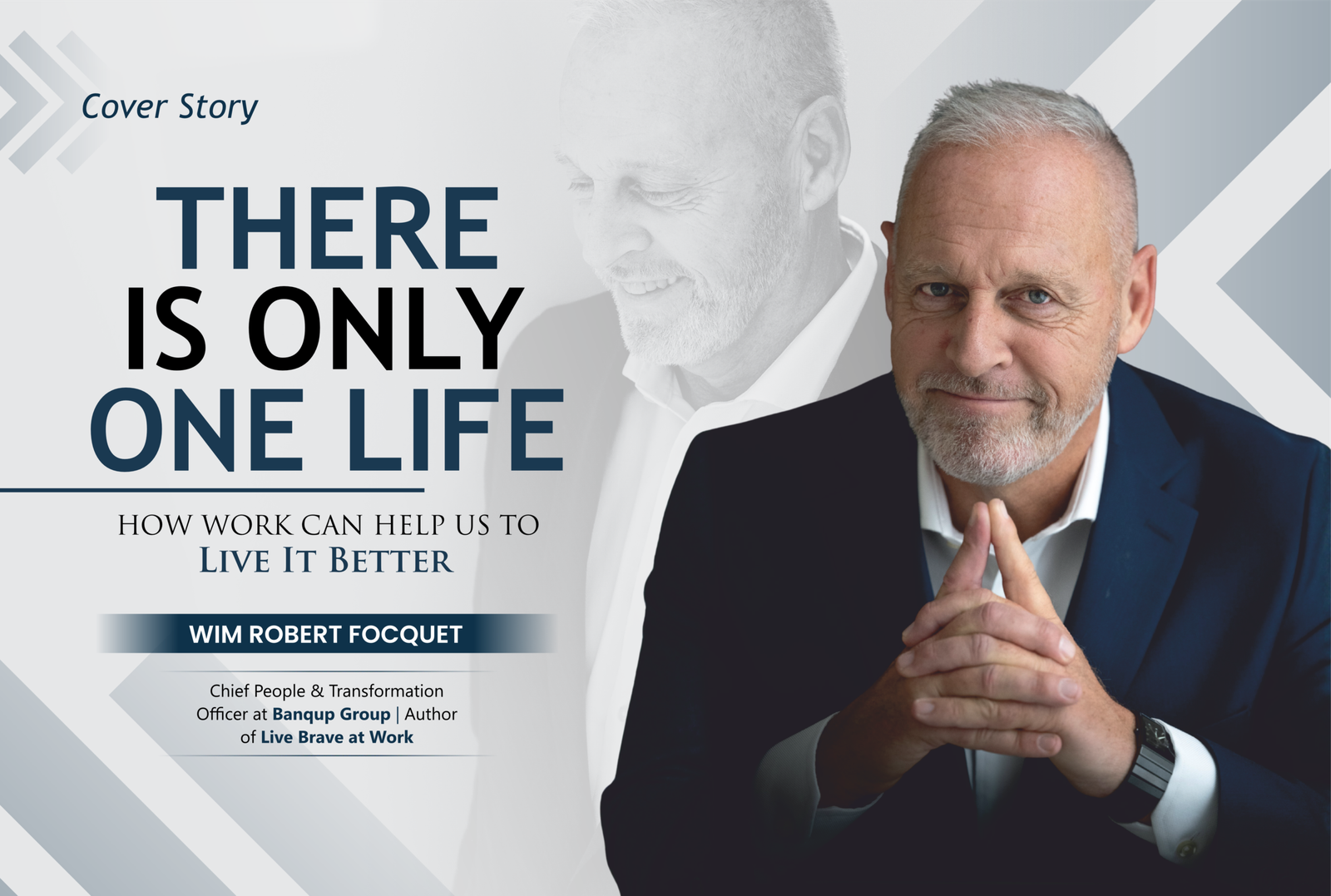
Every Organisation Asks People to Give Something of Themselves :
their time, judgement, creativity, ambition and energy. Yet far fewer organisations stop to ask what they give back in return. Beyond salary, promotion and performance reviews lies a more consequential measure of success꞉ do people leave work with greater confidence, broader perspectives, stronger relationships and a deeper sense of purpose than when they arrived?
For Wim Robert Focquet that question has shaped more than three decades of work across executive leadership, organisational transformation, academia, coaching and authorship. As Chief People & Transformation Officer at Banqup Group, founder of The Regenerative Culture Company, educator at IE Business School and author of Live Brave at Work, he has consistently argued that business performance and human development do not have to compete. The strongest organisations can create economic value while also expanding the capacity of the people who create it.
One Life, One Purpose
Every stage of Wim’s career has been driven by a simple purpose꞉ improving the way people live. His professional journey has crossed executive leadership, academia, organisational development, coaching and writing, but he sees these roles as different expressions of the same mission. Work is one of the most influential environments in adult life. What happens there does not remain there.
The confidence people develop professionally affects how they show up as parents, partners, friends and citizens. Their personal wellbeing and sense of purpose, in turn, shape how they collaborate, lead and make decisions. For Wim, the familiar idea of work‑life balance therefore starts from a false division. We are not two people balancing two lives. There is only one life.
People Leadership Is Business Strategy
At Banqup Group, Wim sees people leadership as a strategic business function rather than a support discipline. In a fintech environment shaped by artificial intelligence changing customer expectations and regulatory shifts, organisational capability must evolve as quickly as business strategy. That means going beyond talent programmes or organisation charts. It means simplifying structures, clarifying decision rights, strengthening accountability and helping teams navigate uncertainty without creating dependency. Leaders cannot remove uncertainty, but they can create enough clarity for people to act, learn and adjust.
Technology alone cannot create organisational success. As more routine work is automated, judgement, creativity, collaboration, ethical reasoning and trust become more valuable, not less. The future Chief People Officer is therefore not merely a steward of HR processes, but a business leader responsible for ensuring that human and organisational capability keeps pace with technological and commercial change.
Building Positive‑Sum Organisations
Wim challenges the assumption that companies must choose between profitability and humanity. Instead, he advocates a positive‑sum model in which employees, customers, shareholders and society benefit through mutually reinforcing relationships.
Investment in people should improve customer experience, trust, execution and financial performance. Profitability matters because it creates the capacity to invest, innovate and endure. Regeneration is not the opposite of performance. Done properly, it is a way of creating performance that renews the capacity to perform again.
That principle becomes especially important during restructuring and transformation. Leadership is measured not by the decisions that are made, but by the way they are made and executed. Transparency, respect, honest communication and genuine dialogue become more important when the choices are difficult, not less.
Designing Organisations That Renew
Years of observing organisations across industries led Wim to a recurring paradox꞉ companies often invest heavily in strategy and digital transformation while paying insufficient attention to the people and relationships responsible for delivering them. This insight helped shape The Regenerative Culture Company and the wider body of work behind Live Brave at Work.
Sustainability asks how we preserve value and reduce harm. Regeneration goes one step further꞉ how do we renew and expand the vitality of people, relationships and organisational capability? A regenerative organisation should leave people more confident, capable and purposeful than when they joined. This thinking also informed Org‑ Lab, an initiative designed to bridge the gap between strategic ambition and everyday execution. Rather than relying on transformation programmes alone, the focus is on how work actually happens꞉ who owns what, how decisions are made, where unnecessary approval has accumulated and where organisational complexity is consuming energy.
Creating Regenerative Cultures
One of the largest hidden costs in organisations is what Wim calls organisational noise꞉ unnecessary meetings, unclear decision rights, duplicated work, excessive approval flows and endless communication loops. Organisations often compensate for a lack of genuine attention by communicating more ‑ repeating messages, launching new campaigns and restating promises that everyday reality does not support.
Real listening reduces that noise. When people receive genuine attention, their concerns are understood and leaders act consistently on what they hear, communication becomes simpler and more credible.
Removing hidden complexity allows organisations to become faster and quieter while restoring craftsmanship, accountability, professional ownership and trust.
Engagement asks whether people feel connected and committed. Wellbeing asks whether they can thrive sustainably. Regeneration asks something further꞉ are people actually growing because of the work they do? A regenerative workplace treats the working day itself as a developmental environment.
Every decision either adds energy to the system or depletes it.
Regeneration is not created by isolated wellbeing initiatives or annual surveys. It is created through thousands of daily interactions. Every conversation, promotion, customer commitment and leadership decision either adds energy to the organisation or gradually depletes it. Living systems do not grow because they are controlled. They grow because every part contributes to the vitality of the whole.
From Values to Everyday Behaviour
Culture is not created by mission statements or values displayed on office walls. Leaders shape the conditions, but culture is co‑created through thousands of daily choices made throughout the organisation. Every conversation, customer interaction, act of courage or avoidance reinforces the organisation people actually experience.
For meaningful transformation to occur, behaviour must come before communication. Employees judge culture less by what leaders occasionally say than by what they repeatedly do, especially when pressure rises. One simple principle used in Banqup’s transformation is ‘Start with the customer.’ Its power lies not in the wording, but in the discipline of using customer value rather than organisational convenience as a decision criterion.
Wim’s BRAVE CIRCLE and Brave Compass are designed in the same spirit꞉ not as mechanical scorecards, but as developmental practices that help leaders examine the person behind the professional role and the quality of the system they are helping to create.
Leadership That Builds Others
For Wim, great leadership is measured less by personal achievement than by the capability it leaves behind. Leaders do not simply deliver results; they shape environments in which people discover potential, strengthen relationships and gain the confidence to contribute beyond what they thought possible.
In a regenerative organisation, success is therefore measured not only by what the business produces, but also by who people become while producing it. Exceptional leaders create clarity, build ownership, listen with genuine intent, use constructive challenge and think beyond immediate performance metrics.
The enduring question is simple꞉ what kind of people are emerging because they work here? The strongest leaders leave behind people who are more capable of leading themselves and others.
AI Makes Humanity More Valuable
Wim rejects the idea that organisations must choose between technological progress and humanity. The more capable technology becomes, the more valuable distinctly human qualities become꞉ judgement, empathy, creativity, ethical reasoning, courage and trust. The greater risk is not that artificial intelligence will automatically make people irrelevant. It is that people and organisations stop evolving because yesterday’s expertise still feels sufficient. Technology raises the premium on continuous learning. Organisations therefore have a responsibility to make development part of everyday work rather than confining it to occasional training.
Learning to Keep Evolving
Through his work at IE Business School, Wim has seen a clear shift in what leadership demands. Previous generations were often rewarded for expertise and certainty. Today’s leaders must also be able to remain curious, adapt and learn continuously.
The same challenge applies inwardly. The qualities that once contributed to a leader’s success can become limitations if they are never reconsidered. The decisive expert may struggle to ask for help. The dependable problem‑solver may keep solving issues others should own. High achievers may leave too little time for reflection. Leadership growth therefore requires both learning and unlearning꞉ replacing certainty with curiosity, control with trust and personal achievement with collective success. Leadership is not a destination. It is a continuing practice of awareness, adaptation and renewal.
Ideas That Move People
As a writer and keynote speaker, Wim has learned that information alone rarely creates change. People move when an idea helps them see differently, releases energy and gives them confidence to translate that energy into action.
His approach combines frameworks with stories and concrete examples. The intention is not to simplify ideas until their substance disappears, but to make complexity understandable without making it superficial. Authenticity and vulnerability matter because people recognise quickly when communication is polished but disconnected from lived reality.
The Future Is Human‑ Centred
In the coming years, artificial intelligence, automation and digital transformation will continue to reshape organisations. Yet technology itself will not determine which companies succeed. The harder ‑ to‑copy advantage will be cultural꞉ the ability to learn, adapt, build trust and remain genuinely connected to customer value.
As technology becomes widely available, organisations will differentiate themselves through the quality of the human system around it. Those that empower people, keep learning, reduce organisational noise and focus relentlessly on creating value will be better equipped to thrive.
There is only one life. Organisations are among the most powerful places where that life unfolds. They can exhaust it or enrich it. They can reduce people to resources or help them become more fully themselves.
If organisations exist to create value, then perhaps the greatest value they can create is not found on a balance sheet alone, but also in the lives, capabilities and relationships of the people who make that value possible.
“My life’s goal has always been to improve the way people live.”
“I have never believed that work and life are separate. We are one person, living one life.”
“Organizations should not merely create economic value; they should develop the people who make that value possible.”