
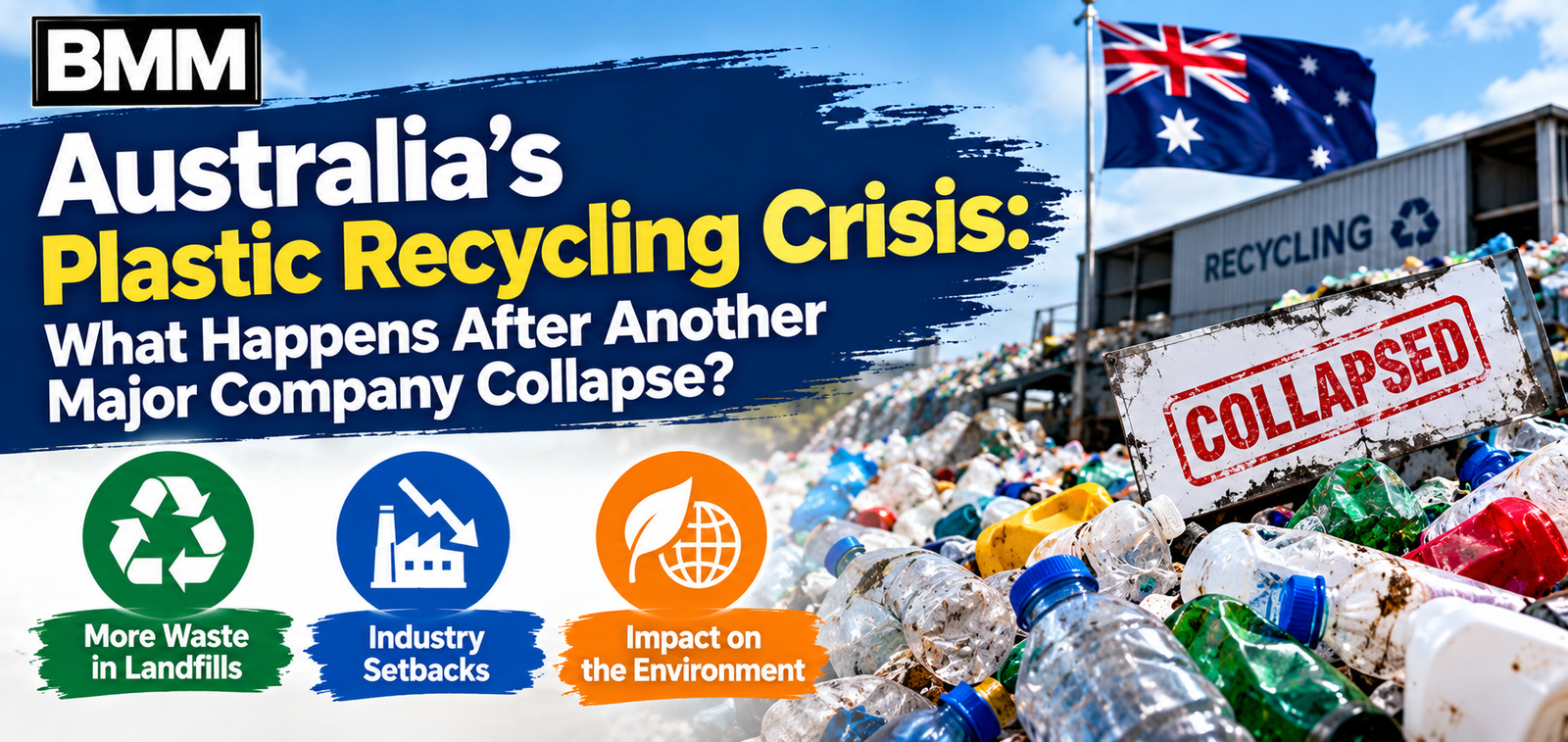
Australia’s plastic waste problem has been building for years, but the recent collapse of another major recycling operator has once again exposed the fragility of the country’s recycling infrastructure. The latest setback comes as Recycling Plastics Australia (RPA), one of the nation’s largest recycling businesses, entered voluntary administration, raising fresh concerns about the future of plastic recovery and circular economy initiatives across the country.
The event has reignited discussions surrounding the Australia plastic recycling crisis, highlighting long-standing issues involving processing capacity, market demand, policy implementation, and the viability of recycling businesses operating in a challenging economic environment.
A System Under Pressure
It is common knowledge that Australia produces millions of tonnes of plastic waste annually, but not all of it finds its way back into the economy through recycling. The Department of Climate Change, Energy, the Environment and Water reports that Australia consumed about 4 million tonnes of plastic products and packaging in the year 2023-24. Out of the 3.2 million tonnes that reached the end of their life cycle, only 13% were recycled, while the overall recovery rate was 14%.
From these numbers, it becomes clear that there is a huge disparity between plastic consumption and recycling. In spite of growing consumer awareness and the efforts of companies towards more sustainable practices, there have not been enough facilities to recycle the used plastic material.
Consequently, the management of Recycling Plastics Australia sees a problem not just with one company but with the whole recycling industry.
Lessons from Previous Failures
The most recent failure cannot help but be compared to REDcycle, an extremely popular plastic recycling program in Australia until its collapse in 2022. The sudden closure of REDcycle surprised consumers when it became known that tons of plastics collected by the program were being stockpiled due to the inability of processing plants to process all the material collected.
Until the failure of REDcycle, Australians thought that they were helping to recycle plastics in a responsible manner by using supermarket collection bins. But the problem is far more complex than what meets the eye.
While things have improved to some extent since then, there are still issues from which the recycling industry has not been able to fully recover.
Why Recycling Businesses Struggle
A lot of people believe that Australian plastic recycling companies are expected to flourish as consciousness about the environment rises. However, the truth is quite the opposite.
Plastic recyclers have to work under harsh economic conditions. In fact, virgin plastic can cost less than recycled plastic, resulting in a decreased need for recycled plastic. Also, recyclers encounter increased costs of energy, labour, transportation, and volatile commodity prices.
The issue only becomes exacerbated if there is an expansion of collection systems without a corresponding increase in processing capacity. The above fact played a significant role in the failure of REDcycle and is the current challenge faced by many Australian plastic recycling companies.
If there is no guaranteed demand for manufacturers to purchase recycled material, recycling enterprises fail to earn a profit.
The Soft Plastic Challenge
One of the most difficult areas remains Australia soft plastic recycling. Soft plastics include bread bags, chip packets, frozen food packaging, cling wrap, and other flexible materials commonly found in households.
Contrary to rigid plastics, sorting and handling soft plastics is problematic due to the presence of several layers of varying materials. The contamination from food residues makes recycling even more difficult. Consequently, the rate of success in recycling such plastic is extremely low. According to industry data, a negligible proportion of Australia soft plastic recycling, while the majority of it is disposed in landfills.
The failure of the REDcycle system deprived the nation of its largest system for collecting consumer soft plastics. Subsequently, many supermarkets, authorities, and industries attempted to recreate this capability through various pilots and stewardship programs.
Fortunately, some of these difficulties have been overcome by the creation of new facilities.
Signs of Progress Amid the Crisis
Despite all the problems, however, there is also some good news about the industry.
Australia has greatly increased the reprocessing capacity within the country over recent years. According to official statistics, the country’s plastic reprocessing capacity has increased significantly, which means that there are new possibilities for increased recycling on the local market and not sending the waste abroad.
There is even a trend toward developing large-scale capacities. For instance, the Soft Plastic Engineered Commodity facility in New South Wales is able to handle thousands of tons of household soft plastics annually.
According to the industry representatives, the soft plastic industry is currently operating on a significantly larger scale compared to the peak of the REDcycle period, which means that there have been some lessons learned from previous mistakes.
Nevertheless, capacity alone is not enough for solving the problem. There should be stable markets for recycled materials and better collaboration in the industry chain.
Understanding Australia’s Recycling Rate
The relatively low Australia plastic recycling rate continues to concern policymakers and environmental groups.
Australia plastic recycling rate have increased, Australia still sends the overwhelming majority of plastic waste to landfill. Government reporting indicates that approximately 87% of plastics leaving the use phase ultimately go directly to landfill rather than being recovered.
Several factors contribute to this outcome:
- Complex packaging designs that are difficult to recycle
- Insufficient collection systems in some regions
- Limited processing infrastructure
- Weak demand for recycled materials
- Consumer confusion about recycling requirements
Improving recycling rates will require coordinated action across manufacturers, retailers, recyclers, governments, and consumers.
The Role of Plastic Recycling Symbols
Another challenge involves consumer understanding of Australian plastic recycling symbols.
Many Australians believe that all plastics that have recycling symbols on them can be recycled using kerbside recycling services. However, recycling depends on many factors, including material, ability of the council, and processing facilities available.
Initiatives like Australian plastic recycling symbols have tried to make things easier for people by informing them about whether they should recycle their packaging at kerbside bins, bring them back to the shops, or just throw them away with general waste.
Labeling is important for reducing contamination and improving recycling efforts, but it requires appropriate processing facilities.
What Happens Next?
Another lesson provided by the administration of Recycling Plastics Australia is that the Australian recycling transition has not yet been completed successfully.
The country has achieved some progress since the failure of REDcycle; now, it has more facilities for processing, more processing, and has developed industry-wide stewardship programs.
Still, the economics of the process is not very favorable.
For the future, it has become more and more obvious that the responsibility for plastic recycling should not be carried only by recyclers and consumers, but packaging producers, retailers and product designers should be involved in the process as well through the development of more easily recyclable materials and creation of markets for recycled material.
Therefore, Australia’s future in the sphere of plastic recycling should include the development of a process that is not only environmentally friendly but economically viable as well.
Until the latter goal is achieved, the collapse of every new company may become another lesson showing that it is much easier to collect plastics than to recycle them back to valuable materials.
Australia plastic recycling problem is thus not a waste management problem. It is an issue of infrastructure, economics, and policy. What is going to happen after
FAQ
What is happening with plastic recycling in Australia?
Australia’s plastic recycling industry is facing financial and operational pressure. The recent voluntary administration of Recycling Plastics Australia has raised concerns about the capacity and long-term stability of the sector.
Why did Recycling Plastics Australia collapse?
Recycling Plastics Australia entered voluntary administration on 31 August 2026. Administrators are now assessing the company’s financial position and seeking potential investors or buyers.
What happens to plastic waste after a recycling company collapses?
Plastic waste may be redirected to other recycling facilities if sufficient capacity exists. Otherwise, materials can be stockpiled, sent to landfill or potentially exported, depending on the type of plastic and available processing options.
Is Australia running out of plastic recycling capacity?
The industry has significant capacity, but the challenge is making recycling financially viable and ensuring there is enough demand for recycled materials. Recent industry concerns show that capacity alone does not guarantee a stable recycling system.
What happened to REDcycle in Australia?
REDcycle, a major soft-plastics collection scheme, collapsed in 2022 after it said it could not find enough recyclers to process the collected material. Large stockpiles were subsequently discovered across several states.
Will another plastic recycling company replace Recycling Plastics Australia?
Potentially. Administrators are seeking expressions of interest from investors or buyers, so the company’s assets and operations could potentially continue under new ownership.
What does the recycling crisis mean for Australian households?
Consumers may face changes to where and how certain plastics can be recycled. If processing capacity becomes limited, some materials may no longer be accepted through particular collection programs.
Can Australians still recycle soft plastics?
Yes. Australia has been developing new soft-plastics collection and recycling arrangements following the REDcycle collapse. The industry says the new system has substantially greater processing capacity than REDcycle had at its peak.
Why is plastic recycling so difficult in Australia?
Plastic recycling can be expensive because materials need to be collected, sorted, cleaned and processed. Different plastic types also require different treatment, while demand and prices for recycled plastic can fluctuate.
What can the Australian government do about the recycling crisis?
Possible measures include stronger producer-responsibility rules, incentives for recycled materials, better recycling infrastructure and policies that create stable demand for recycled plastic. Industry groups have called for stronger national packaging reforms.