
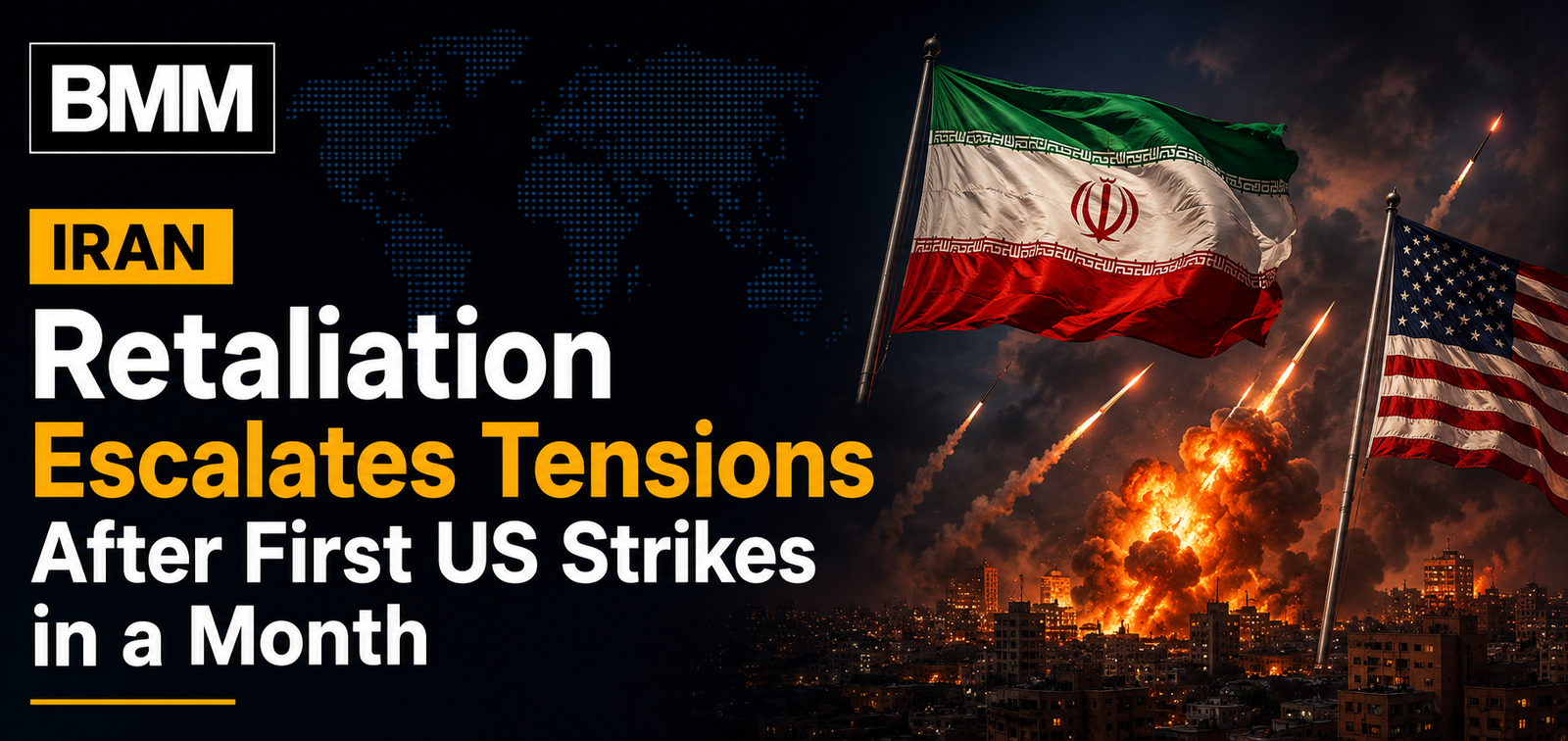
The Middle East witnessed a renewed surge in tensions after Iran retaliation followed the first direct US military strikes in nearly a month. The exchange marks a significant escalation in an already volatile regional conflict and raises fresh concerns about the security of critical energy routes, regional stability, and the possibility of a broader confrontation involving multiple countries. According to reports, US forces targeted Iranian military assets near the Strait of Hormuz, prompting Tehran to launch retaliatory missile attacks against US-linked targets in the region.
US Military Action Ends Weeks of Relative Calm
The latest crisis began when the United States carried out strikes against Iranian rocket launchers positioned near Larak Island in the Strait of Hormuz. US officials stated that the operation was intended to prevent Iranian forces from deploying rockets and sea mines that could threaten international shipping through one of the world’s most important maritime corridors. The strikes represented the first confirmed US military action against Iran in approximately a month, ending a period of relative calm between the two sides.
Washington described the operation as a limited and defensive measure aimed at protecting maritime traffic. The Strait of Hormuz remains a vital route for global energy supplies, making any military activity in the area a matter of international concern.
Iran Retaliation Targets US Positions
Iranian response came fast after the strikes. The government of Iran announced casualties due to the strikes by the US and took the next step of firing ballistic missiles at US military installations in Jordan. According to Iranian state media, the attacks were directed against key infrastructure facilities that housed the troops of America.
However, while most of the fired missiles were intercepted according to US officials and those from neighboring countries, the act of retaliation proved that Iran was prepared for taking revenge in the form of direct military action.
Strait of Hormuz Remains at the Center of the Crisis
One of the reasons why there is tension at the moment is the significance of the Strait of Hormuz for strategic purposes. Almost one-fifth of all oil traded in the world transits through the strait, which makes it necessary to secure its safety in order to avoid any trouble in global markets.
The latest Iran retaliation has drawn more attention to the strait, since all parties try to find out whether other military steps will affect commercial shipping through the strait or not.
Growing Regional and International Concerns
However, the new round of negotiations between the US and Iran is causing alarm among both regional partners and international players. Many countries have called for restraint in light of the potential escalation, as it might increase instability in the entire Middle East region.
As many analysts say, it should be noted that this new Iran retaliation comes against the backdrop of a fragile geopolitical situation. The existing tensions with Israel, Gulf countries, and other regional militant organizations make any military operations very risky.
Impact on Global Markets
Financial markets reacted carefully to the renewal of hostilities. There was pressure on oil prices as traders considered the possibility of any interruption in the supply of energy resources. The maritime flow of traffic passing through the Strait of Hormuz has fallen sharply when compared to its normal levels due to increased concerns regarding security.
The impact of further Iran retaliation and U.S. military operations would go beyond the energy market. It can also have an effect on global economies if the tension level stays high.
What Comes Next?
The latest Iran retaliation serves to illustrate just how delicate the current situation is in regard to relations between Iran and the US. Although both parties have presented their respective actions as self-defense measures, this particular scenario reveals how rapidly events can escalate in such a strategically crucial part of the world.
With the armed forces on standby and diplomacy encountering considerable difficulties, the following weeks will prove crucial in deciding whether the situation will be defused or continue heading down the path of confrontation. In any case, the world keeps its eyes open as what happens in the Gulf region has implications far beyond just Middle Eastern security concerns.