
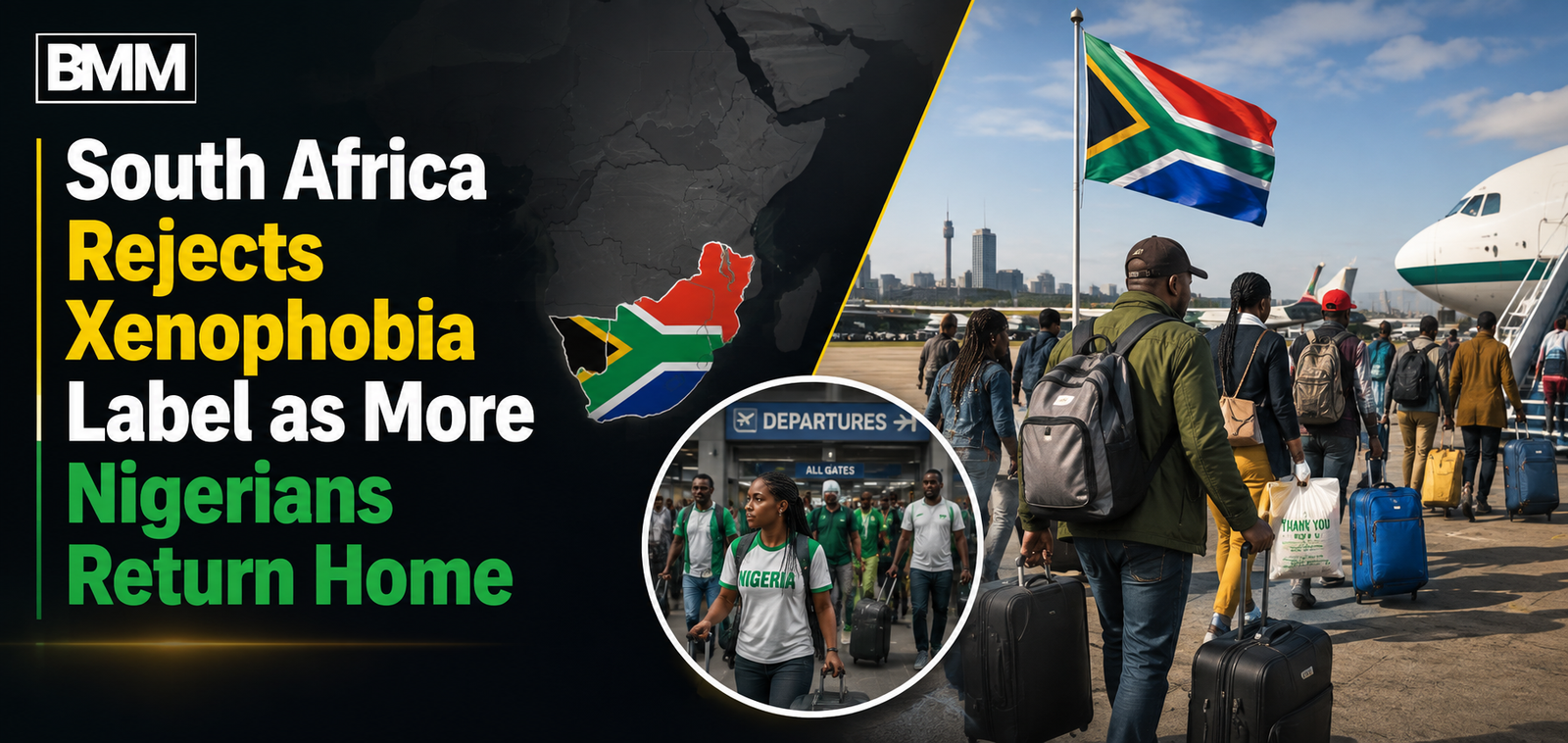
A fresh group of 83 Nigerians is expected to return home from South Africa, weeks after Nigeria completed a major evacuation exercise involving more than 1,400 citizens. The latest repatriation effort, facilitated by private sponsors, comes amid ongoing concerns over anti-immigrant violence and tensions involving foreign nationals in South Africa.
The development has once again placed the spotlight on Xenophobia in South Africa, a topic that has sparked debate across Africa and drawn reactions from governments, civil society groups, and diplomatic representatives.
South Africa Rejects the Xenophobic Label
South African government authorities have made it clear that South Africa is not xenophobic. According to the Consul General of South Africa in Lagos, Bobby Moroe, one cannot use a few incidents of violence in a country to generalize about the whole nation. He confirmed the fact that some violent attacks had been taking place in the country but added that one should take into account other problems such as managing migration, unemployment and pressure on public resources.
According to him, there are many immigrants living in the country, and the constitution of South Africa offers legal rights to all citizens. According to him, discussions about Xenophobia in South Africa should be grounded in facts rather than assumptions.
Growing Concerns Among Nigerian Nationals
Despite the above stance by South Africa, there are still Nigerians who have expressed worries about their security and future within the country. This year, for instance, more than 1,000 Nigerians have applied for repatriation voluntarily after experiencing threats and attacks as well as anti-immigration demonstrations. The government of Nigeria evacuated around 1,490 Nigerians from South Africa.
The problems facing those who returned home included social hostility and difficulty in reapplying for migration papers. Some cited fear caused by the anti-immigrants’ demonstrations in different areas.
These experiences have fueled ongoing discussions about Xenophobia in South Africa and its impact on migrant communities.
Economic Pressures and Immigration Debate
It is noted by analysts that the immigration discourse in South Africa is tied to more general issues faced by the economy. South Africa still suffers from issues like unemployment, inequality, and the strain on public services. It is in this context that immigrants are scapegoated for all the issues in society, despite research and crime statistics proving the contrary.
President Cyril Ramaphosa has openly condemned the attacks on foreign nationals and vowed action against those behind these attacks. It is stressed by him that the immigration crackdown must be done by the state alone.
The debate surrounding Xenophobia in South Africa therefore remains complex, involving both legitimate concerns about immigration management and allegations of discrimination against foreign communities.
Impact on Regional Relations
This problem has also had an impact on diplomatic relations between South Africa and other African nations, including Nigeria. The Nigerian government has constantly been seeking assurances about the protection of their nationals, whereas South African officials have been trying to reassure neighbouring countries that violence against immigrants is not part of official government policy.
It is believed that further conflicts will hamper the efforts of African nations in building closer ties and cooperation with each other. Due to the considerable weight that both Nigeria and South Africa carry in the African political environment, communication should be maintained.
Looking Ahead
As yet another wave of Nigerians returns home, the issue of Xenophobia in South Africa is not likely to fade away from the discussion any time soon. Even though the South African government dismisses the issue and stresses the constitutionality of the country’s policies on immigration, the issues highlighted by immigrants and other foreign governments influence the debate. The difficulty will be how to combine effective migration control with social harmony and safety of all citizens of South Africa. The manner in which South Africa responds to these issues in the following months will be decisive in whether the debate about Xenophobia in