
When Minutes Decide Millions
Why leading auto insurers should rethink their hail catastrophe strategy
$5.6 billion, that is what State Farm, the largest U.S. insurer, paid out for hail claims in 2025 alone. In March 2026, the National Weather Service recorded more than 650 hail events across nine states in a single day. That same month, Midwest storms triggered over 50,000 claims. The central question for U.S. auto insurers is no longer whether the next major event will come, but how fast they can respond to it.
The New Reality of Hail Risk in the U.S.
For a long time, hail was a calculable seasonal risk in the American insurance landscape. That era is over. NOAA recorded more than 5,400 hail events across the U.S. in 2025, and the trend is rising. Texas and Illinois lead the statistics, followed by Missouri, Wisconsin, and Oklahoma. Severe convective storms caused $51 billion in insured losses in 2025 – a number that puts the entire claims ecosystem under pressure.
The real challenge is not the number of events but their intensity. When tens of thousands of vehicles are damaged within hours, traditional repair shop networks reach their breaking point. Claims departments struggle with delayed inspections, inaccurate estimates, high supplement rates, and declining customer satisfaction. Per-vehicle repair costs for severe damage now easily exceed $10,000 – particularly for aluminum bodies and vehicles with ADAS (Advanced Driver-Assistance Systems) that require recalibration after repair. What insurers need is not another repair partner. They need a system built for catastrophic loss.
Built to Scale: A Systemic Approach
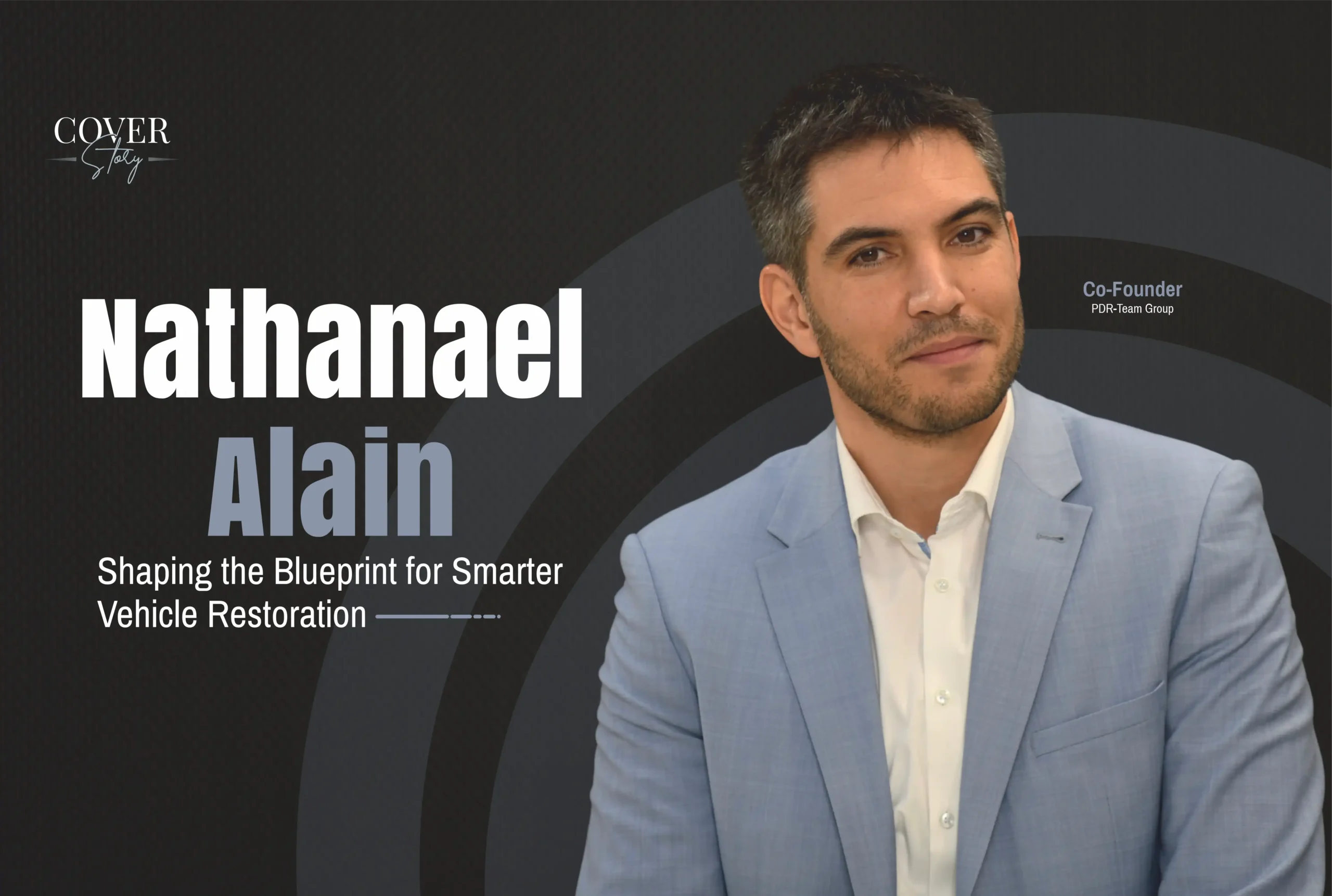
That is exactly what PDR-Team has been pursuing since its founding in 2010. Two co-founders, one shared vision: Nathanael Alain brings years of experience as an automotive engineer, project management, scaling, and international client relationships. Arthur Vogel learned Paintless Dent Repair (PDR) from the ground up and developed it over the years into an industrialized process. Together, they founded the company on October 1, 2010, in Berlin. A family business that today operates on four continents – turning the combination of engineering precision and industrialized craftsmanship into its competitive edge.
The group’s headquarters is in Mutlangen, Germany. More than 350 specialized technicians work within a coordinated network across Germany, France, Switzerland, Belgium, Poland, Australia, South Africa, and the U.S. – supported by a proprietary software infrastructure. What started as a regional hail specialist has grown into a globally scalable platform for catastrophic loss management.
From Market Entry to Operational Readiness: The U.S. Operation
PDR-Team has been operational in the U.S. for two years, headquartered in Lewisville, Texas. Its operational reach today spans eight states: Texas, Colorado, Kansas, Minnesota, Wisconsin, Montana, Missouri, and Virginia. This means the company is positioned exactly where hail risk drives insurer claim costs the most – from the classic hail corridor through Tornado Alley to the Rocky Mountains and the East Coast.
For the 2026 hail season, nearly 50 Colibri 3D scanners will be ready for deployment worldwide – ten of them in the U.S., five in standard size and five in an XL variant developed specifically for U.S.-typical vehicles: pickup trucks, dullys, and lifted pickups. This scanner generation does not exist anywhere else on the market in this size. It is the answer to a simple reality: anyone who wants to handle hail damage at scale in the U.S. needs equipment built for U.S. vehicles.
Co-founder Arthur Vogel plays a central role in the company’s global expansion and hail damage operations – including in the U.S. What has grown in Europe over more than a decade – proven processes, proprietary technology, and consistent technician qualifications – is being translated into the U.S. market. Not as a European solution exported abroad, but adapted to U.S. conditions.
The Colibri Advantage: From Estimation to Measurement
Until 2014, hail damage assessment across the industry was essentially a visual estimate. PDR-Team turned it into a measurement. The proprietary Colibri scanner generates a precise 3D model of every vehicle in just three minutes. Every dent is identified, measured, and fully documented – including those the human eye cannot detect. The system can even trace back to individual hail events: a damage pattern from storm A can be distinguished from a damage pattern from storm B.
For claims departments, that is an operational paradigm shift. Disputes over which shop counted how many dents disappear. The estimating basis is reliable from the start. Cycle times shrink. Fraud detection improves through complete digital documentation. And the results flow through more than 30 established interfaces directly into common U.S. claims platforms – without carriers needing to implement new systems.
48 Hours to Deployment: The Operational Reality
When a major event hits, every minute counts. That is why the PDR-Team keeps equipment, scanners, light tunnels, and mobile repair infrastructure permanently on standby. Within 48 hours, a complete hail site is set up on location: not just the technology, but a seasoned team that has been working together at every major event for years. Each site can inspect up to 400 vehicles per day.
For the policyholder, that means: instead of waiting weeks for an appointment, they get help immediately – without having to transport their vehicle hundreds of miles. For the carrier, it means measurably shorter cycle times, higher repair rates instead of cash settlements where preferred, and stronger customer retention after major events. PDR-Team adapts to each
client’s specific requirements. Exactly where traditional repair shop networks reach their limits, the PDR-Team system begins to scale.
More Than Technology: The Team as a Competitive Edge
As advanced as the technology is, on its own, it makes no difference. That is one of the founding family’s core convictions from day one. Better technology can be built by someone else tomorrow. What cannot be replicated are people who, for ten or fifteen years, have known how to perform under pressure.
A hail season lasts six months on average, sometimes longer. When a storm hits on a Friday evening, the team gets in the truck and works through the weekend, so that everything is ready by Monday morning. This kind of commitment is not written into contracts – it is culture. “This isn’t a job, it’s an attitude,” Alain says. That attitude is the actual scaling foundation of PDR-Team.
Repair Instead of Replace: The Economic Logic of Sustainability
PDR – Paintless Dent Repair – is more than a method. It is an economic and environmental principle. Dents are removed without paint, without replacement parts, without altering the vehicle’s original condition. For carriers, that means lower claim costs and fewer total losses. For policyholders, it means faster service and no loss in resale value. For the environment, it means less paint, less material waste, and a smaller CO₂ footprint.
The fact that these three interests – carriers, vehicle owners, and the environment – converge in one model is not a marketing argument. It is the operational DNA of the company.
CAREOSS: When Paint Comes Into Play
Not every type of damage can be repaired without paint. CAREOSS was built precisely for those cases, as PDR-Team’s sister company, specialized in more complex bodywork, paintwork, and accident damage. With around 15 locations across multiple countries, carriers can handle the entire claim through a single partner – even when hail damage and bodywork damage occur together. What PDR-Team cannot remove without paint is handled by CAREOSS – with the same standards in digitization, quality, and speed.
What This Means Concretely for U.S. Carriers
Three things, says Nathanael Alain, make the difference for a claims director. First: fewer supplements. Colibri’s precise digital damage capture eliminates classic post-repair negotiations between shops and carriers from the outset. Second: lower claim costs. When the estimating basis is right from the start, the correction loops disappear – and in practice, those often cost more than the original repair. Third: minimal implementation effort. Through established interfaces, PDR-Team integrates into existing system landscapes without requiring carriers to roll out new infrastructure, new processes, or additional IT projects.
“It works exactly the way claims departments are used to,” Alain says. “It’s plug & play.”
In an industry where major events are becoming the norm and claims directors are increasingly under pressure, that is the actual message: less stress for the team, predictable costs, and more satisfied policyholders. With the tailwind of a new strategic partner – the Solvd Group – PDR-Team is taking the next scaling step in the U.S. market. What has grown in Europe over more than a decade is now ready to deliver its full impact there.
Quick Facts
- Founded: October 1, 2010 in Berlin
- Headquarters: Mutlangen, Germany
- Active in: 8 countries (DE, FR, CH, BE, PL, ZA, AU, US)
- U.S. Operation: PDR-Team Inc., Lewisville, Texas — operating in 8 states for 2 years
- Specialists: more than 350
- Colibri scanners ready for 2026 season: nearly 50 worldwide, including 10 in the U.S. (5 standard, 5 XL variant for U.S. trucks)
- Co-Founders: Nathanael Alain, Arthur Vogel
- Sister company: CAREOSS — around 15 locations for bodywork and accident damage
“Until 2014, hail damage assessment was estimation. Today it’s measurement.”
“This isn’t a job, it’s an attitude.”
“It works exactly the way claims departments are used to. It’s plug & play.”
Also Read: Business Minds Media for more information