
The earliest years of a child’s life are not merely a prelude to learning; they are the very architecture of possibility. Long before a child enters a formal classroom, the mind is already building its first bridges to language, trust, curiosity, and imagination. It is during these formative years that confidence is quietly born, emotional resilience begins to take shape, and the foundations of future learning are laid with extraordinary precision. When access to quality early education is absent, the loss is not always immediately visible, yet its consequences echo across a lifetime. A child denied stimulation, structure, and nurturing guidance at this stage is often asked to begin the race several steps behind. To invest in early learning, therefore, is not simply to educate; it is to alter the trajectory of lives, families, and generations.
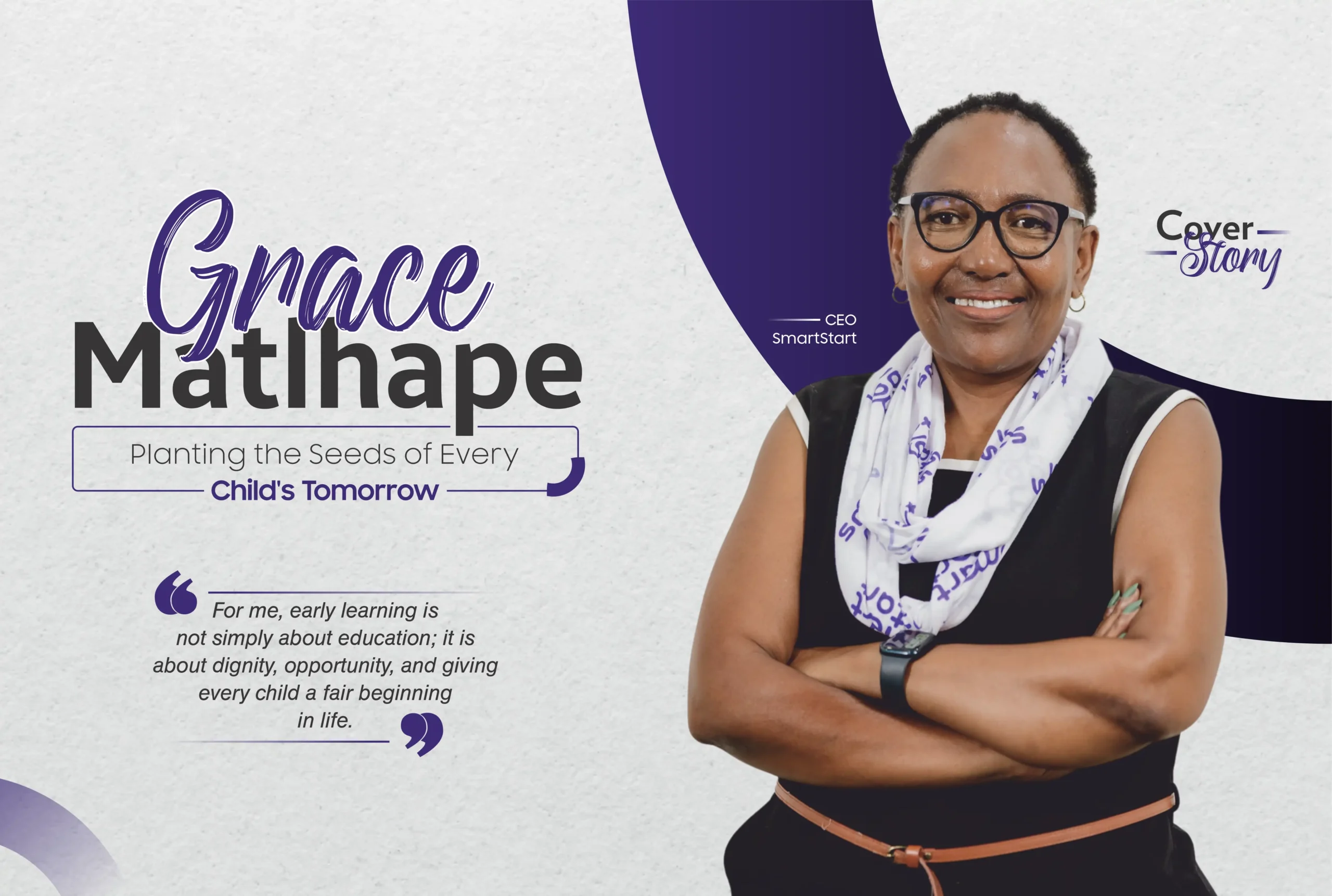
This belief finds powerful expression in the work of Grace Matlhape, the CEO of SmartStart, whose mission is to transform the way early learning reaches children across South Africa. Through an innovative community-based model, the organization brings quality education closer to families by enabling women within local communities to run accessible early learning programmes from homes and shared spaces.
The Calling Behind a Life of Impact
Grace’s journey as a social entrepreneur has been profoundly shaped by her lived experience of inequality in South Africa and a deep commitment to creating lasting social transformation. Growing up in a country still marked by the legacy of apartheid, she witnessed firsthand the systemic disparities that denied millions of children and families equal opportunities. For Grace, this was never simply a matter of unfairness; it represented a tragic loss of human potential.
Her professional path was built on addressing these structural challenges. Before leading SmartStart, Grace served as the CEO of LoveLife, a nationally recognized organization focused on HIV prevention and social and behavioral change among young people. This experience immersed her in the realities of large-scale social issues across education and health sectors in sub-Saharan Africa. It was here that she developed the ability to build broad social movements, engage communities on sensitive issues, and translate research into practical impact.
Through her work with adolescents and youth, Grace came to recognize that many of the challenges faced later in life often begin in the earliest years of childhood. This realization strengthened her belief that meaningful and sustainable social change must begin at the foundation. Leading SmartStart, therefore, became both a professional and deeply personal mission, driven by her conviction that investing in early childhood development is one of the most powerful ways to break cycles of poverty and inequality.
Medals of Merit
Recently, SmartStart was named a recipient of the prestigious 2026 Skoll Award for Social Innovation, joining just two other organizations globally to receive this distinguished recognition. The Skoll Foundation, established by eBay’s first president Jeff Skoll, grants this award to only a select few organizations worldwide that demonstrate proven impact, potential for exponential scale, and the ability to drive systems-level change on critical global challenges. SmartStart was honored for its innovative social franchise model that simultaneously addresses early childhood education access and creates economic opportunities for women in underserved communities across South Africa.
“This recognition strengthens our resolve to tackle poverty at its roots, because there is no way we can put up a fight against poverty without working on the system as a whole,” said CEO Grace upon receiving the award at the 23rd annual Skoll World Forum in Oxford. “Early childhood development is one of the most powerful levers we have to break the cycle of intergenerational poverty, and this award helps us deepen and scale that work. The recognition truly belongs to the thousands of women in the SmartStart network and to our implementation partners, whose hard work and commitment are changing children’s lives every day.” The award positions SmartStart among an elite cohort of past Skoll Awardees that includes globally recognized organizations such as Teach For All, Partners In Health, and Room to Read, organizations that have collectively impacted millions of lives through scalable, sustainable models of social change.
A Vision for One Million Young Minds
The bold vision of reaching one million children between the ages of three and five every year by 2030 stems from the urgent reality that nearly 1.3 million children in South Africa still lack access to quality early learning. For Grace, this is not merely a statistic but a reflection of a critical developmental gap that continues to widen social and economic inequality.
This ambitious target reflects a moral commitment to ensuring that every child has the strongest possible start in life. Under Grace’s leadership, SmartStart’s strategy for 2026 to 2031 focuses on an open platform approach and collective ecosystem coordination.
Central to this strategy is the evolution of SmartStart into an enabling platform that allows other organizations, partners, and stakeholders within the early childhood development ecosystem to benefit from and contribute to its tools, content, and network. By opening the platform to wider collaboration, Grace aims to significantly extend the organization’s reach beyond its direct network.
Another key pillar of this vision is ecosystem coordination, where government bodies, NGOs, private sector partners, and communities work together toward a shared goal of universal access to early learning. Alongside this, SmartStart continues to strengthen its social franchising model by training and licensing women micro entrepreneurs who can deliver quality learning programmes within their own communities.
The goal is not only to improve developmental outcomes for children but also to create economic opportunities for women and build a stronger, more inclusive early learning system for South Africa.
The Barriers That Still Stand in the Way
From Grace’s perspective, South Africa’s early learning crisis is the result of deeply interconnected systemic barriers.
The most immediate challenge is the lack of affordability and geographic access. Many children, especially those living in rural, peri-urban, and informal settlements, simply do not have nearby access to quality early learning programmes. Traditional early childhood centers are often too expensive for families and too far from the communities that need them most.
Grace also points to fragmentation within the broader early childhood development ecosystem as a major obstacle. Historically, efforts across government, social organizations, and funding partners have often been disconnected, leading to uneven access and inconsistent quality. This fragmentation has left many vulnerable communities underserved.
Another critical barrier she identifies is the limited economic opportunity available to women in low-income communities. Many women possess the nurturing skills and community trust necessary to become excellent practitioners, yet they lack sustainable employment pathways. This reduces the supply of quality early learning services.
Grace also believes that early childhood development has historically been undervalued, often viewed as childminding rather than a critical developmental intervention. This perception has contributed to insufficient policy support and public investment.
Bringing Education Closer to Every Child
Grace believes that the home and community-based model is central to reaching underserved communities more effectively than traditional systems.
By using existing homes and community spaces rather than purpose-built infrastructure, the model dramatically reduces startup and operational costs. This makes programmes more affordable for families and allows services to be established directly within underserved communities.
A major strength of this approach is trust. Practitioners are women from within the same communities they serve, making parents more comfortable and confident in entrusting their children to them. This local presence also ensures that learning remains culturally relevant and responsive to community needs.
At the same time, the model creates sustainable economic opportunities for women by transforming community care into viable microenterprises. This is a dual impact strategy that strengthens both early learning access and women’s economic empowerment.
Most importantly, the decentralized nature of the model enables rapid scale. Rather than waiting years for infrastructure development, SmartStart can quickly train and license practitioners, bringing quality early learning to thousands of children across South Africa.
This approach represents not only an education model but a pathway toward social equity, economic inclusion, and long-term national development.
The Power of Partnerships in Building an Ecosystem
For Grace, partnerships are not merely a supporting element of SmartStart’s work but the very force that binds and strengthens South Africa’s early learning ecosystem. She firmly believes that no single institution can solve the country’s early childhood development crisis in isolation. Instead, meaningful progress depends on bringing together government, private sector leaders, funders, and community organizations into one coordinated system of change.
Her collaboration with the Department of Basic Education is central to creating long-term structural impact. Through this partnership, SmartStart contributes research, policy insights, and strategic frameworks that have helped shape the country’s national ECD agenda. Grace highlights how these collaborations have also contributed to unlocking substantial public funding and strengthening subsidy pathways, ensuring that community-based learning models become part of sustainable national systems.
At the same time, private sector partners bring resources, scale, innovation, and financial discipline. Grace sees them as crucial in helping SmartStart think beyond traditional grant cycles and toward sustainable, outcome-based models of funding and growth.
Community organizations, meanwhile, remain the heart of implementation. Their local knowledge, trust, and day-to-day engagement with practitioners and families ensure that the model remains grounded in the realities of the communities it serves.
Lessons from Scaling Impact at the National Level
Reflecting on SmartStart’s expansion, Grace describes scaling social impact as a journey shaped by both humility and constant learning.
One of the most important lessons she has learned is the need to balance structure with flexibility. In its earlier phases, SmartStart relied on a highly standardized social franchising model, which was essential for ensuring quality and consistency. However, Grace soon recognized that while standardization creates a strong foundation, it alone cannot achieve universal access.
This realization led to a strategic shift toward a more open platform model that allows wider participation across the ecosystem. For Grace, scaling impact means moving from being solely a service provider to becoming an enabler of system-wide transformation.
She also emphasizes the importance of people-centered design. At the core of SmartStart’s growth are the thousands of women practitioners who run the programmes. Understanding their aspirations, challenges, and realities has been fundamental to building a model that is both scalable and sustainable.
Changing the Life Trajectory of Every Child
Grace believes that early learning interventions have the power to fundamentally change the life trajectory of children growing up in poverty.
For her, the statistics around learning readiness and inequality are not abstract figures but a reflection of systemic injustice. She stresses that the earliest years of life represent a critical window for cognitive, emotional, and social development.
When children receive quality early learning during this stage, they are significantly more likely to enter school prepared, perform better academically, remain in education longer, and eventually access better economic opportunities.
Grace sees early childhood development as one of the most effective tools for breaking intergenerational cycles of poverty and inequality.
The Women Driving Grassroots Change
At the center of SmartStart’s model is the empowerment of community-based practitioners, most of whom are women.
Grace views these women as far more than service providers. To her, they are local leaders, entrepreneurs, and agents of transformation within their communities.
SmartStart equips them through holistic support that combines training in early learning pedagogy with practical business and entrepreneurial skills. This approach ensures that practitioners are able not only to deliver quality education but also to build sustainable livelihoods.
For Grace, supporting these women strengthens entire communities by creating stable incomes, economic dignity, and stronger support systems for children and families.
Beyond the Classroom into Economic Growth
Grace sees early learning as a driver of far broader social and economic transformation.
Beyond education, SmartStart’s work directly contributes to employment creation, especially for women. More than 15,000 women have built sustainable micro-enterprises through the organization’s model.
At the same time, affordable and reliable childcare allows other caregivers, particularly mothers, to re-enter the workforce, pursue education, or start businesses of their own.
Grace believes this ripple effect extends to national growth. By strengthening the developmental foundation of children while simultaneously expanding economic participation for adults, early learning becomes an investment in long-term human capital, productivity, and national stability.
A Blueprint for Global Early Learning Systems
For policymakers and global stakeholders, Grace believes SmartStart offers lessons that extend far beyond South Africa.
One of the most important lessons, in her view, is the value of leveraging existing community assets rather than waiting for expensive infrastructure. By using homes and local venues, quality learning can be delivered at scale and at lower cost.
She also emphasizes the importance of building systems rather than isolated programmes. Through social franchising and ecosystem coordination, SmartStart demonstrates how multiple actors can contribute to a shared national vision.
Another key lesson lies in embedding economic empowerment within the model itself. For Grace, solutions become far more resilient when practitioners are able to generate sustainable livelihoods.
She also strongly advocates for robust data systems that inform policy, improve programme design, and strengthen long-term investment cases.
A Future Where Every Child Begins with Hope
Looking ahead, Grace’s vision is one of universal access and systemic transformation.
She envisions a South Africa where quality early learning is no longer a privilege but a guaranteed right for every child, regardless of geography or economic circumstance.
Her long-term hope is for a coherent national ecosystem in which government, communities, civil society, and the private sector work in alignment to ensure stable funding, consistent quality, and broad accessibility.
For Grace, the future of early childhood education lies in changing the national narrative itself, positioning early learning as one of the most important investments the country can make in its people, its economy, and its future.
I have always believed that the earliest years of a child’s life hold the power to shape not only their future, but the future of an entire nation.”
“For me, early learning is not simply about education; it is about dignity, opportunity, and giving every child a fair beginning in life.”
“When we invest in young children, we are not only nurturing minds, we are breaking cycles of poverty and building stronger communities.”
Also Read: Business Minds Media for more information