
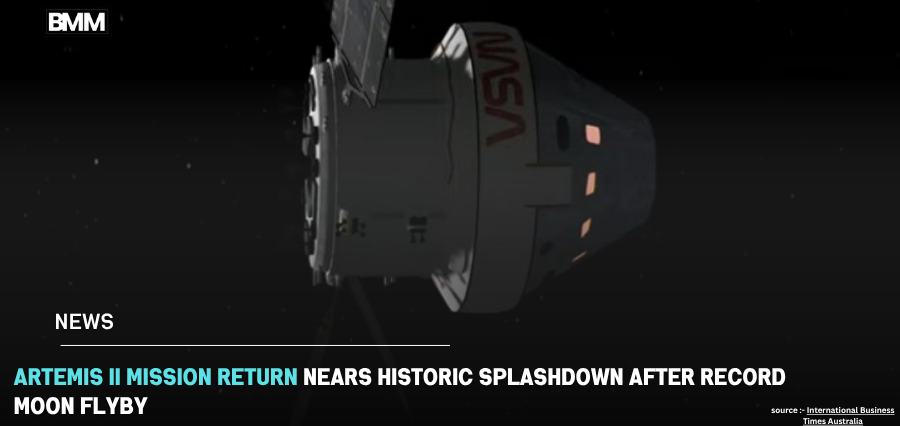
The lunar mission by NASA is in its most dramatic stage with the Artemis II Mission Return, which will see four astronauts back on Earth after the historic journey around the moon. The crew, who have flown on the Orion capsule, will splash down off the coast of Southern California on Friday evening, and this will end a mission that has lasted almost 10 days, and it will make its mark in space history. It is the first crewed lunar flyby in over 50 years and is being considered a significant step to the NASA-wide Artemis program, which will see humans back on the moon and, over time, create a sustained lunar presence.
Historic Journey Beyond the Moon
Artemis II Mission Return is a historic flight that saw astronauts travel farther than any human has ever traveled. This week, the crew members had crossed about 252,000 miles of the Earth’s surface, breaking the long-distance record of the astronauts of Apollo 13, which was 56 years old.
The crew includes:
- Reid Wiseman
- Victor Glover
- Christina Koch
- Jeremy Hansen
They flew over the shady side of the moon, providing scientists with infrequent real-time images and data of deep space.
Emotional First Press Conference From Space
In a press conference aboard the ship during their initial voyage into space, the astronauts were eloquently able to talk about the emotional concerns of the mission.
Pilot Victor Glover termed the upcoming re-entry as a profound one, stating that the crew was yet to digest the historic experience. The astronauts further talked of having concise yet fruitful discussions with their families throughout the mission, which provided a personal touch to the scientific success.
Commander Reid Wiseman was thinking of how he would listen to his crewmates talk to their loved ones, which highlights the human aspect of the Artemis II Mission Return.
The Most Dangerous Phase Begins
Atmospheric re-entry will be the most critical point of the Artemis II Mission Return.
When Orion sinks back to the Earth, it is likely to travel at almost 23,839 mph, creating immense heat due to atmospheric friction. This fiery descent will put the spacecraft’s heat shield to a major test.
The shield of the capsule should be able to withstand temperatures up to thousands of degrees since it is shielding the crew.
According to NASA officials, the stage is also considered to be one of the most hazardous in the whole mission, and thus, the splashdown on Friday was a much-anticipated event.
Why This Mission Matters?
The Artemis II Mission Return is more than the end of a single flight. It is an essential stepping block to moon landings in the future.
The Artemis project of NASA will have astronauts back to the moon by 2028, and future missions are set to make the US presence on the moon sustainable and ready for future missions to Mars.
Astronaut Christina Koch explained the Artemis missions as a relay race, with each milestone intended to propel the next crew further.
Looking Ahead to Artemis III and Beyond
The second significant event after the Artemis II Mission Return will be the Artemis III, which will likely test key docking operations in orbit as NASA prepares to launch lunar landing systems in the future.
The next crewed lunar landing mission is projected to be Artemis IV, planned to be launched in 2028, since Apollo 17 in 1972.
This renders the present mission an essential demonstration of the concept of deep-space travel, spacecraft longevity, and human viability.
Final Countdown to Splashdown
The crew will land in the waters off San Diego towards the end of Friday evening, ending one of the most historic space missions in the modern world.
Not only does the Artemis II Mission Return rejuvenate the exploration of space beyond Earth orbit, but it also offers the spacecraft the foundation of the next phase of lunar exploration.
Also Read :- US Iran Ceasefire Opens New Diplomatic Window Amid Strait of Hormuz Recovery