
Cities are not accidents. They are the sum of thousands of decisions, many of them invisible, made long before concrete is poured or doors are opened. Between land and skyline lies a discipline that determines how people move, gather, feel, and return. Real estate development, at its highest level, is not about scale or speed. It is about restraint, foresight, and the ability to imagine consequences decades ahead. It asks difficult questions of space, culture, capital, and responsibility, and demands answers that can withstand time rather than trends.
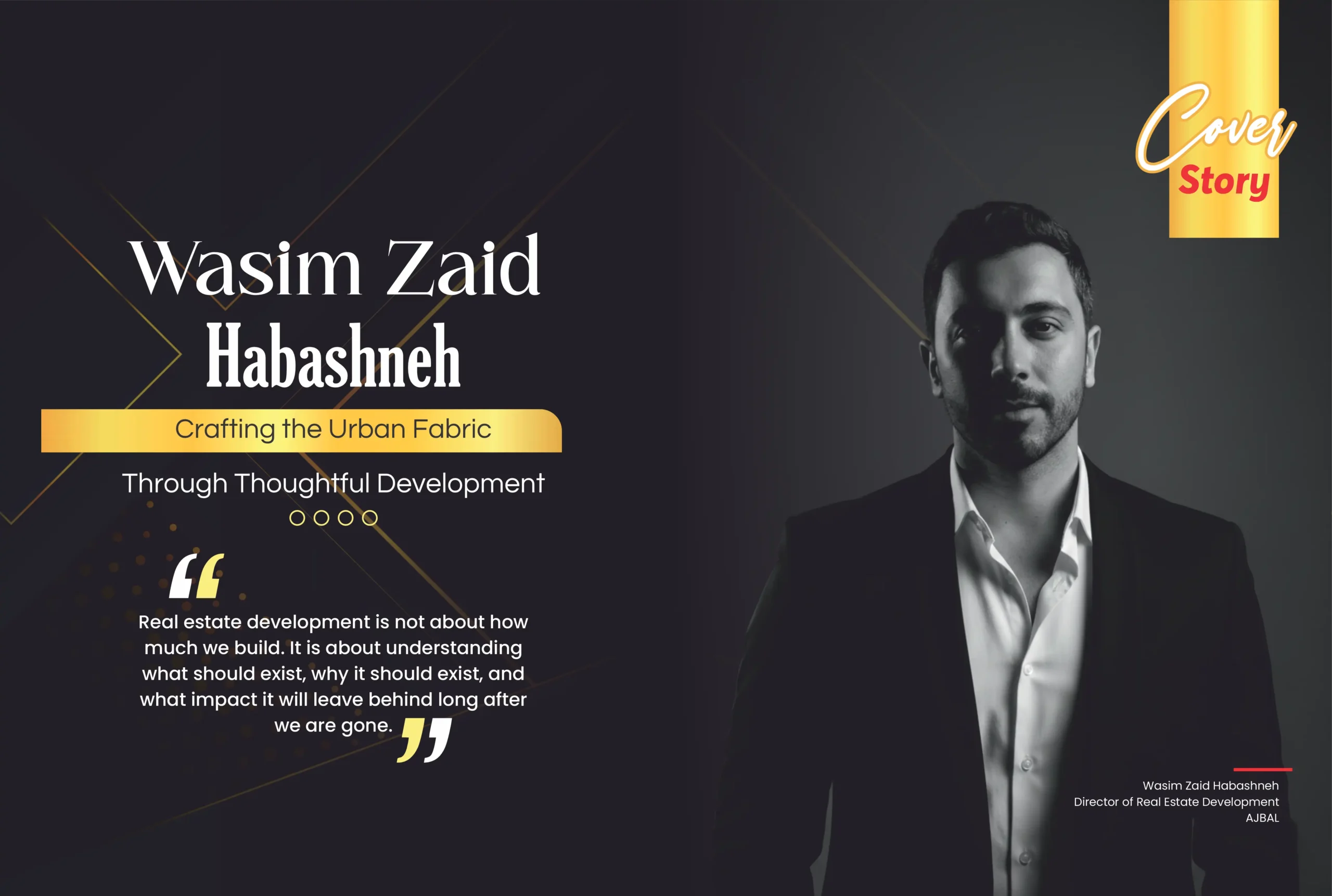
Wasim Zaid Habashneh works within this quiet margin where decisions shape cities long before they become visible. As Director of Real Estate Development at AJBAL, he is responsible for guiding land from possibility to purpose, ensuring that what is built carries intention as well as viability. Trained as an architect and shaped by artistic practice, he approaches development as a layered system rather than a linear process, where spatial logic, human behavior, and long-term value must align.
An Architectural Mindset in Development
Wasim’s foundation in architecture continues to shape the way he approaches real estate development at a strategic level. Architecture, for him, was never only about drawing buildings. It was about learning to think deeply before building anything at all. The discipline trained him to understand context, sequence, and consequence long before form takes shape. As an architect, he learned to imagine how a space would be experienced, navigated, and lived in well before it was constructed.
That mindset carried seamlessly into his transition into real estate development. Rather than viewing projects purely through financial metrics or isolated asset values, Wasim approaches development as a layered system. He evaluates land and opportunity through multiple lenses at once. These include spatial potential, human behavior, regulatory frameworks, financial feasibility, and long-term urban impact. Architecture gave him the ability to zoom into fine detail without losing sight of the whole picture, a skill that is critical in development, where early decisions can shape outcomes for decades.
Equally important is the discipline architecture instilled in him. Constraints were never obstacles but design inputs. This way of thinking translates directly into strategic development decisions, whether defining the highest and best use of land, structuring mixed-use programs, or aligning design intent with commercial realities. For Wasim, architecture is not a past chapter but an operating system that continues to guide his leadership.
Creativity as a Commercial Asset
Wasim Zaid Habashneh does not see creativity and commercial viability as opposing forces. In his view, the most commercially resilient developments are those that people emotionally connect with. Art, when used with intention, is not decoration. It is a tool for meaning, identity, and differentiation.
His role is to translate creative ideas into systems that can be built, operated, and sustained over time. Every creative gesture must justify its place within the project. It must improve user experience, reinforce identity, or enhance long-term value. If it does not serve one of these purposes, it does not belong in the development.
Balance comes from asking the right questions early in the process. Does the idea strengthen the narrative of the place? Does it add value across the full lifecycle of the asset? Can it be executed and maintained responsibly? When creativity is evaluated through these lenses, it shifts from being perceived as a risk to being understood as a strategic investment.
A Shift in Development Thinking
Over more than fifteen years in the industry, Wasim has witnessed a fundamental shift in how real estate developments are conceived and delivered. The most significant change has been the move from asset-driven development to experience-driven development.
In the past, success was measured primarily through scale, efficiency, and yield. Today, success is increasingly defined by how people live, interact, and feel within a space. Developments are no longer standalone objects. They are ecosystems that must respond to social behavior, cultural context, and long-term use.
This shift has transformed how projects are planned and delivered. Cross-disciplinary collaboration is no longer optional. It is essential. Timelines are more integrated, and operational considerations are addressed much earlier in the process. Technology and data have also reshaped decision-making. Yet despite evolving tools, the core challenge remains unchanged. Creating places that people choose, return to, and care about.
Art as a Development Philosophy
Wasim Zaid Habashneh’s artistic practice has deeply influenced how he approaches development. His work focuses on local materials, cultural context, and storytelling. This practice trained him to respect material honesty and to understand how climate, tradition, and craft inform identity.
Within development, this philosophy translates into a strong emphasis on context-driven design. Concepts are not imposed on land. Meaning is extracted from it. Material choices, spatial proportions, and public realm strategies are informed by local conditions rather than global templates. The result is development that feels grounded and authentic rather than imported.
Storytelling plays a parallel role. Every project carries a narrative, whether articulated or implied. When that narrative is clear, design decisions become coherent and aligned. The final outcome feels intentional rather than assembled. For Wasim, storytelling is not branding. It is a strategic framework that guides decision-making from concept to execution.
Leadership Shaped by Cultural Exposure
Living and working across different countries gave Wasim a multicultural lens that continues to influence both his design thinking and leadership style. Exposure to varied approaches to design, governance, and collaboration taught him that there is no single correct way to build. There are only contextually appropriate ones.
This experience sharpened his ability to listen and adapt. As a leader, he recognizes that teams bring diverse perspectives and that diversity strengthens outcomes when guided with clarity and respect. Culturally, it made him more sensitive to how global best practices must be translated rather than copied into local environments.
Leadership, for Wasim, is about alignment rather than authority. It is about creating frameworks that allow people from different backgrounds to contribute meaningfully while moving toward a shared vision.
Creating Value for Communities
As Director of Real Estate Development, Wasim places strong emphasis on ensuring projects enhance communities rather than simply occupying space. He believes development carries responsibility. Buildings shape behavior, influence social interaction, and leave long term imprints on cities.
Community enhancement begins with understanding how a place functions socially and culturally. It requires listening, observation, and respect for existing patterns. Projects are designed to integrate rather than dominate, to contribute rather than extract. Public realm, accessibility, and social value are considered essential components, not secondary features.
Four Pillars of Decision Making
From due diligence to execution, Wasim Zaid Habashneh evaluates every opportunity through four critical pillars. Context ensures the project fits its environment physically, culturally, and socially. Feasibility confirms it works financially and operationally. Resilience tests its ability to adapt over time in response to market shifts and changing needs. Purpose defines why the project should exist at all.
If any of these pillars are weak, the project will struggle regardless of market conditions. This framework allows him to make disciplined decisions while remaining open to opportunity.
Protecting Vision Across Every Phase
Overseeing planning, design, construction, and leasing requires consistency and clarity. For Wasim, quality is not enforced at the end. It is embedded from the beginning. When vision, objectives, and decision frameworks are defined early, quality becomes easier to protect.
Consistency is achieved through alignment. Teams understand the intent, the values, and the benchmarks from the outset. This clarity allows flexibility without dilution and innovation without compromise.
Innovation Without Recklessness
Risk is unavoidable in development. Wasim Zaid Habashneh approaches uncertainty by separating calculated risk from reckless risk. Innovation requires courage, but it must be grounded in data, testing, and scenario planning.
He protects the core of the project while allowing flexibility at the edges. This approach creates space for bold ideas without undermining stability. Creativity is encouraged, but always within a framework of responsibility.
Craftsmanship as Culture
Wasim Zaid Habashneh is known for valuing craftsmanship and detail. He instills these values not through speeches but through behavior. Expectations are set early. Details are reviewed personally. Teams that demonstrate care and accountability are recognized.
When leadership values quality visibly and consistently, teams mirror those standards. Craftsmanship becomes part of the culture rather than a checklist.
The Ethics of Imagination
His personal quote, “an artist is a prisoner to his imagination, jail with no chains,” reflects a philosophy of responsibility. Imagination is powerful, but it must be disciplined. As a creative leader, Wasim respects creativity while ensuring it serves people, places, and long-term outcomes.
Freedom without responsibility leads to chaos. Creativity with structure leads to progress.
A Legacy Written Between People and Place
Looking ahead, Wasim Zaid Habashneh hopes his legacy will be defined by meaning rather than magnitude. He wants to leave behind places that feel intentional and people who feel empowered. Legacy, for him, is not scale. It is depth.
If his work raises standards, strengthens communities, and helps others grow into thoughtful leaders, that will be enough. Real estate shapes cities. Leadership shapes people. He aims to be responsible in both.
“Real estate development is not about how much we build. It is about understanding what should exist, why it should exist, and what impact it will leave behind long after we are gone.”
“The most powerful decisions in development are made before construction begins. Once those decisions are set, cities follow. My responsibility is to get those moments right.”
“I do not separate creativity from commercial viability. When creativity is disciplined and purposeful, it becomes one of the strongest drivers of long-term value.”
Also Read :- Business Minds Media For More information