
Headlights cut through the early morning fog as a truck driver pushes through long distances to meet a strict delivery window. Miles away, a fleet manager studies a dashboard, hoping every vehicle completes its journey safely and without suspicious fuel activity.
Every vehicle on the road carries more than cargo. It carries deadlines, costs, safety risks, and customer expectations. Behind that responsibility are the fleet management service providers working to give fleet owners the visibility they need to stay in control. But they can’t do it alone.
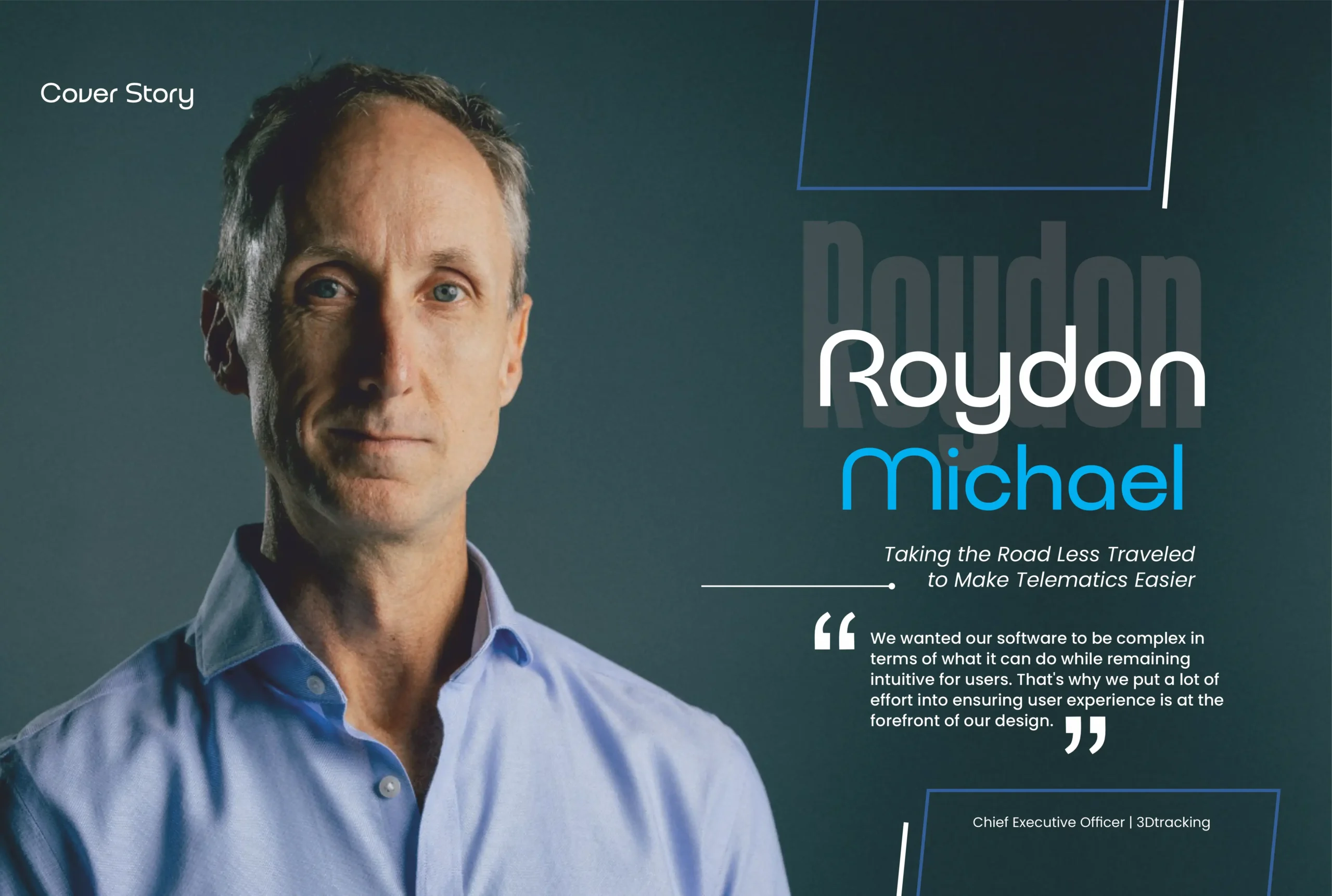
Roydon Michael, Chief Executive Officer of 3Dtracking, understands the pressure facing service providers and fleets today. And more than two decades ago, that understanding helped shape the vision of 3Dtracking, a company built around a simple idea: telematics should make life easier, not more complicated.
Roydon Michael Empowering Service Providers to Exercise Their Superpower
When Roydon Michael https://www.linkedin.com/in/roydon-michael/and co-founder Daryl Schonborn started 3Dtracking, most telematics systems in the market followed a “closed” model. In this setup, the platform developer would sell the tracking device, the software, and the service directly to the end user – the fleet owner.
For fleet management service providers wanting to enter the market, this created a barrier to growth. If they wanted to compete, they needed to build and maintain a platform of their own, an expensive and complex undertaking that required developers, infrastructure, and ongoing technical support.
Technical development was a distraction. It dragged them away from their strengths, their real superpowers: building relationships, supporting clients, and understanding local markets.
Until 3Dtracking emerged as a solution.
Instead of competing with service providers, the company delivered a system and service that allowed them to operate under their own brand while relying on a stable foundation behind the scenes.
“We call our customers partners because we don’t just wait for them to come to us with feature requests and then get on and do the work,” Roydon explains. “We stay close to them, understanding their needs and business goals, to make sure we’re supporting their business growth through our platform and people.”
Uncomplicating Powerful Fleet Technology
As 3Dtracking grew, so did the number of requests coming from partners operating in different industries and regions around the world. Each request solved a real problem somewhere in the market.
But growth brought its own challenge. The system was becoming increasingly powerful, and with that power came the risk of unnecessary complexity.
If every request were implemented without restraint, the platform could eventually become difficult for users to navigate. For Roydon and the wider team, that raised an important question: how do you keep a system powerful without making it overwhelming?
The answer came back to a principle that still guides development today: no partner or user wants their experience to be complicated, regardless of what they are trying to achieve when interacting with the system.
Maintaining that balance – between capability and ease of use -has become a defining discipline across 3Dtracking.
Adding Value Doesn’t Start and Stop with Technology
Many companies equate value with price, assuming the cheapest option automatically delivers the most value. At 3Dtracking, value is approached differently.
Roydon sees value as the balance between cost and the positive impact a solution has on a partner’s business
In the telematics industry, that impact rarely comes from simply adding more features. It comes from helping partners serve their customers better.
That philosophy shows up across 3Dtracking, through technical support teams helping partners solve operational challenges, account managers investing in long-term relationships, and product teams continuously improving the system based on real-world feedback.
Their focus is consistent: if partners succeed, it means the people behind 3Dtracking are doing their job.
Partner-Led Design and Development
Today, 3Dtracking works with partners in more than 150 countries, each supporting their own customer base. Those end customers operate in vastly different environments, across industries and regulations.
No two businesses are exactly alike.
That diversity shapes how the system evolves. Flexibility is not treated as an optional feature, but rather built into the way the platform and supporting services are designed.
Every aspect of the company, from the software itself to the processes surrounding it, aims to support a wide range of users while remaining intuitive to navigate. Achieving that balance requires constant learning and adjustment – something Roydon credits to the experience of the team working closely with partners every day.
Regulation adds another layer of complexity, but Roydon views it as part of the landscape rather than a barrier.
“Regulatory change creates opportunity,” he says. “At the end of the day, our approach is partnership driven. We don’t assume we understand every market better than the people operating in it, so we work very closely with our partners to understand what challenges exist in their specific markets, and we adapt to ensure we deliver compliance.”
Just as importantly, the company has learned that strong partnerships are built on shared philosophy. Over the years, 3Dtracking has turned down potential partnerships where the primary differentiator was price alone. Competing purely on cost often leads to a race to the bottom, whereas partners focused on delivering real value to their customers tend to build stronger and more sustainable businesses.
Gut Feel and Decision-Making
Roydon’s confidence in navigating a fast-moving industry comes largely from experience.
Over decades in leadership roles, he has encountered many of the same patterns in different forms. After seeing how certain decisions play out over time, it becomes easier to recognize familiar signals and move forward with greater clarity.
“I see ‘gut feel’ as being ‘pattern recognition’ rather than simply making decisions based on feeling or emotion,” he explains.
That experience helps Roydon and the leadership team move quickly when new challenges emerge, without losing sight of the long-term direction of the company.
Moving Forward When the Destination Is Ever-Changing
Looking back, Roydon identifies two fundamental steps at the heart of fleet management: collecting data and extracting value from that data[RM1] .
Both are becoming significantly easier today as connectivity improves and data costs continue to fall. Technologies that once seemed out of reach — such as video telematics or direct vehicle telemetry through OBD and CANbus systems — are now entering the mainstream.
Vehicle manufacturers are also embedding telematics capabilities directly into vehicles, allowing fleet operators to access telemetry data through API integrations rather than relying solely on third-party hardware installations.
The result is more data, and easier access to it. But gathering data is only half the equation.
AI and Evolving Expectations
As artificial intelligence becomes more integrated into software platforms, expectations are changing. Systems that simply display information in reports and graphs are no longer enough. Fleet operators increasingly expect platforms to interpret that data, highlight potential risks, and help trigger actions that improve operational efficiency.
Roydon and the 3Dtracking team see this shift happening across the industry. The platforms that stand out in the coming years will be those that turn complex data into practical decisions embedded within everyday workflows.
Clarity Beyond the Office
Leading a company in such a dynamic industry requires clear thinking, and Roydon has found an unexpected way to reset his perspective.
Trail running has become an important part of how he clears mental noise.
When he’s up in the mountains[RM2] , attention shifts completely to the terrain ahead. Each step demands focus, leaving little room for business decisions
By the time the run is over, the noise of the day has usually disappeared, and he has the mental space for fresh thinking.
A Measure of Success
Those moments of clarity often bring Roydon back to the bigger picture.
Part of that bigger picture is the enormous amount of waste caused by inefficiency across the global economy. Every wasted litre of fuel, every tyre replaced too early, and every preventable vehicle breakdown represents lost resources. By helping businesses gain better visibility over their assets and operations, telematics can play a meaningful role in reducing that waste.
If 3Dtracking is truly making telematics easier, its partners should see the impact in their own businesses. What are they achieving in their markets? How are their customers benefiting from better visibility and operational insight?
It’s a question Roydon and his team ask regularly.
Because when partners succeed, their customers succeed. And when that happens, it means 3Dtracking is staying true to its mission: empowering partners to thrive.
“We wanted our software to be complex in terms of what it can do while remaining intuitive for users. That’s why we put a lot of effort into ensuring user experience is at the forefront of our design.”
“I see ‘gut feel’ as being ‘pattern recognition’ rather than simply making decisions based on feeling or emotion.”
“If we can focus 100% on making our partners lives easier, on giving our partners everything they need in order for their businesses to be as successful as possible, then I believe we will be successful alongside them.”
“That focus of identifying and solving the underlying pains of our partners and users is the very core of how we add value, and we apply that thinking to everything in our business.”
Also Read :- Business Minds Media for more information