
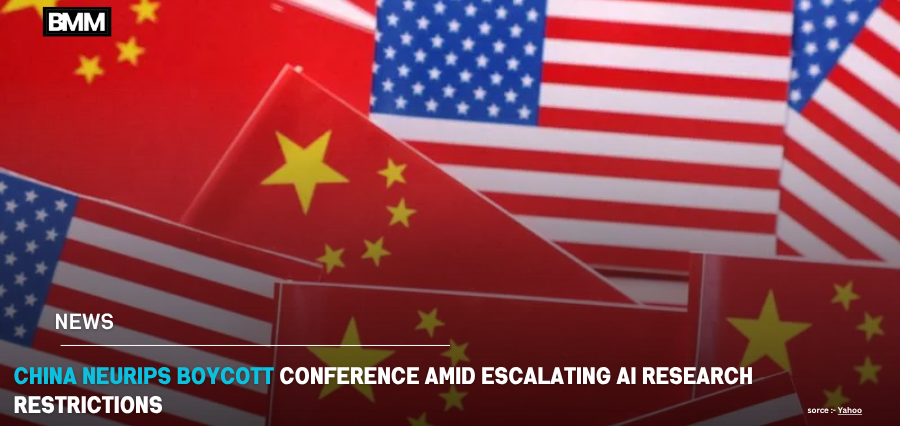
The global artificial intelligence landscape is witnessing fresh tensions as China takes a firm stance against new restrictions imposed by one of the world’s most influential AI conferences. The China NeurIPS boycott marks a significant escalation in the ongoing technological rivalry between China and the United States, signaling how geopolitical decisions are increasingly shaping the future of scientific collaboration.
Policy Shift at Conference on Neural Information Processing Systems Sparks Backlash
The controversy began when the Conference on Neural Information Processing Systems, widely known as NeurIPS, introduced a policy change that prevents entities under U.S. sanctions from submitting research papers. This effectively excludes major Chinese technology firms such as Huawei and SMIC.
NeurIPS, a premier global platform for AI researchers, plays a critical role in shaping innovation, offering peer review opportunities, showcasing breakthroughs, and connecting top talent. The new rules, introduced to comply with U.S. regulations, have triggered widespread criticism in China and directly contributed to the China NeurIPS boycott.
China NeurIPS Association for Science and Technology Responds with Boycott Measures
In response, the China Association for Science and Technology, the country’s largest scientific body, announced it would no longer support participation in NeurIPS. The organization stated it would stop accepting funding applications for researchers planning to attend the conference.
Instead, CAST will redirect funding toward domestic events and international platforms that it believes respect the rights of Chinese academics. This move formalizes the China NeurIPS boycott and reflects a broader shift toward strengthening China’s independent research ecosystem.
Impact on Academic Recognition and Research Funding
The China NeurIPS boycott has further implications on the attendance of conferences. NeurIPS also cast that papers that are accepted to the conference will not be related as recognized research outputs in its funding programs. Although some papers of this nature can still be recognised based on their scholarly merit, they will not have the equivalent institutional credibility in the Chinese system of funding.
Such a choice has the potential to have a profound effect on the localization of publications by Chinese researchers, so the widespread increase of domestic AI conferences and journals may come sooner.
Geopolitics Reshaping AI Collaboration
The China NeurIPS boycott underscores a broader trend where geopolitical tensions are increasingly influencing scientific research. The United States and China are engaged in a high stakes race to dominate artificial intelligence, with both nations leveraging policy and regulation to gain strategic advantages.
Washington has intensified scrutiny of Chinese researchers in recent years, particularly those affiliated with institutions linked to mainland China. Investigations into alleged ties and concerns over intellectual property have led to tighter controls and increased oversight.
Sanctions and Technology Restrictions Intensify Divide
The boycott of China NeurIPS highlights a bigger trend of geopolitical tensions having greater power over scientific work. Artificial intelligence is a high stakes race between the United States and China that the two countries use policy and regulation to gain strategic benefits.
Over the last few years, Washington has been putting a lot of attention on investigating Chinese researchers, specifically those of the institutions associated with mainland China. There has been more control and oversight as a result of investigations into so-called connections and fears on intellectual property.
A Shift Toward Self Reliance in AI Research
The response of China indicates an increase in self-reliance in science and technology. The country seeks to develop its own artificial intelligence centers of excellence by motivating the researchers to concentrate on the domestic platforms.
The boycott of NeurIPS in China can boost the investment in local conferences, research facilities and development of talent. In the long term, it may lead to a decrease in reliance on Western platforms and reorganize the entire world of AI research.
A Divided Future for Global AI
The China NeurIPS boycott does not just represent a response to one policy change. It is a more profound change in conducting global science as the geopolitical tension is on the rise. With the United States and China in a continuing rivalry with regards to technological dominance, the two countries might find themselves competing rather than collaborating.
It is still unclear what the long-term effect of such a divide would be, however, one thing is evident. Innovation is the only way that artificial intelligence will determine the future but the political forces that will shape it include who will be involved to get it.
Also Read :- Denmark Election Results Reshape Political Landscape as Coalition Talks Begin