
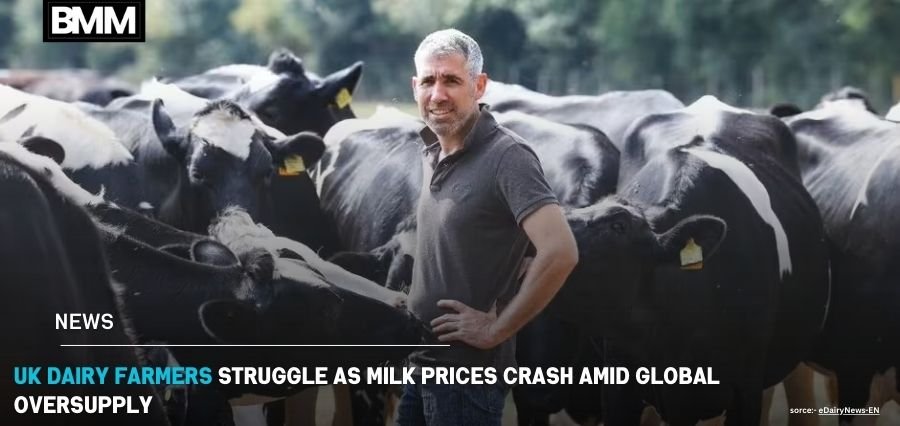
The UK dairy crisis is deepening as milk prices continue to fall sharply, leaving farmers across Britain struggling to stay profitable. A surge in global milk production, combined with weakening demand, has created a supply glut that is pushing many dairy producers toward financial distress and potential closure.
Falling Prices Push Farmers Into Losses
Dairy farmers Kelly and Ed Seaton, who rear 200 pedigree Holstein cows in northwest England, are among those hit hardest. With production costs at around 40 pence per litre and payments dropping to just 30.5 pence per litre, the couple expects to incur losses this year.
The rapid decline in prices highlights the severity of the UK dairy crisis, with farmers receiving up to 15 pence less per litre, a drop of nearly 40 percent since October 2025. For many, this sharp fall has made dairy farming economically unsustainable.
Oversupply Flooding the Market
At the heart of the UK dairy crisis is a classic supply and demand imbalance. Milk production has surged both domestically and globally, exceeding the capacity of processors such as cheese and yoghurt manufacturers.
In the UK, supply is outpacing consumer demand, leaving processors unable to absorb the excess. Industry experts describe the situation as too much milk in the market, a sentiment echoed by farmers facing mounting financial pressure
Globally, milk production has rebounded strongly in 2026 following a weaker 2025, further intensifying the glut. This international oversupply has amplified price volatility, directly impacting UK farmers.
Fewer Farms But Higher Yields
Even though there is a decline of about 20 percent in the number of dairy farms, which started to drop to approximately 7,000 by 2019, the dairy crisis in the UK is still present. In January, the milking herd of the UK was at its lowest level of 1.6 million cows in a decade, but overall milk production has risen.
The existence of enhanced productivity is one of the reasons. The drought that followed last year compelled farmers to consume less milk on grazing and more on concentrated feed, which increased the milk produced per cow. Although this has increased production, it has also added to the existing oversupply issue.
Global Pressures and Market Volatility
The case of the UK dairy crisis is not exclusive. Milk is a commodity that is traded across the world, hence the prices of milk in the UK are affected by the global market trends. In Europe and the United States, there has been increased production that has contributed to worldwide overproduction. Some countries have responded by demanding emergency measures. Italy, as an example, has supported the European Commission to start subsidizing storage and promoting production reduction, but nothing has been done.
The state of affairs was characterized as a milk tsunami by the French dairy association FNIL, which emphasized the magnitude of the world imbalance of farmers all over.
Farmers at the Mercy of Processors
According to many farmers in the UK, pricing is out of reach. The market is dominated by large processors who include Muller, Arla, and First Milk, which also means that producers are price takers and not price makers.
Incomes of farmers such as the Seatons, whose milk gets processed into Red Leicester-style cheese, have declined drastically. Their monthly revenue will be 20,000 pounds lower than it was only a few months ago.
Equally, Welsh farmer Gwyndaf Thomas, who has 300 Friesian cows, said that the new prices are worse and unprecedented in magnitude. This is experienced in the wider UK dairy crisis, where farmers have very little time to adjust to extreme and rapid price drops.
An Uncertain Future for the Industry
The current Uk dairy crisis brings about intense concerns regarding the future of this industry. As the profitability is under strain, an increasing number of farmers could leave the industry and the number of dairy producers would decrease even faster.
The UK is almost 90 percent self-sufficient in the dairy industry but since it is exposed to global markets, the stability of prices is questionable. The crisis may escalate further unless intervention is done or a change in supply and demand effect takes place.
In the meantime, farmers are still working under accumulating financial pressure in the hope that the market will correct itself and this will be a long time coming.|
Also Read :- Google Explores AI Data Center Liquid Cooling Partnerships with Chinese Suppliers