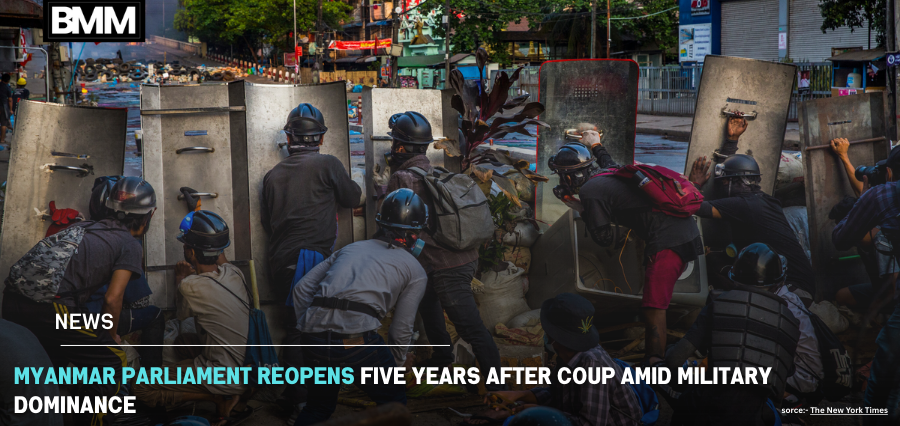
Myanmar has taken a controversial step toward what its ruling authorities describe as a return to civilian governance. The Myanmar parliament reopening on Monday marked the first time lawmakers gathered since the military seized power in a coup five years ago. However, analysts and international observers argue that the new political structure continues to be heavily controlled by the military leadership.
The parliamentary session follows a recent election that was widely criticized by Western governments and opposition groups. Many believe the process was designed to legitimize the military’s continued influence rather than restore genuine democratic governance.
Myanmar Parliament Reopening After Years of Political Turmoil
The Myanmar parliament reopening comes after the country endured five years of political instability, civil conflict, and international isolation. In 2021, Myanmar’s armed forces overthrew the elected government of Nobel laureate Aung San Suu Kyi, just as her party was preparing to begin a second five year term following a decisive election victory.
The coup triggered widespread protests across the country and eventually escalated into a prolonged civil war. Armed resistance groups formed across several regions, while millions of civilians have been affected by violence, displacement, and humanitarian challenges.
Against this backdrop, the military government organized a phased election earlier this year, paving the way for the Myanmar parliament reopening and the formation of a new legislature.
Army Backed Party Dominates the Election
The recent election saw the triumph of the Union Solidarity and Development Party (USDP), which is a political party that is strongly associated with the military establishment. The USDP secured some 81 percent of the available seats in the parliament with no party posing a threat and the lack of voter participation.
After reopening of the Myanmar parliament, the USDP chairman and retired brigadier general, Khin Yi, was made a lower house speaker. He had been acclaimed to take the office and analysts indicated that his position may prove very important in assisting the military to push its political agendas in the legislature.
It is observed that a good number of opposition parties boycotted the election or were prohibited to participate in the election which casts doubt on the credibility of the electoral process.
Military Dominance in the Legislature
Although the Myanmar parliament has reopened, the constitution of the country still makes the military to retain substantial political power. By the provisions of the constitution 25 percent of seats in parliament are automatically allocated to the military officers who are directly appointed by the military.
This has ensured that the military has an influential bloc in the legislature before the good electoral performance of the USDP.
According to political scholars, this system is effective in that it puts the new parliament under the military rule. Under the leadership of the armed forces and their associated party, the legislature is likely to be very much compatible with the interests of the military administration.
Htin Kyaw Aye, an independent analyst, called the new parliament mostly a mere symbolism which implies that the new parliament is unlikely to make any significant political reforms.
In his opinion, the reopening of the Myanmar parliament can be viewed as a policy by the military in order to reform its system of governance without letting go of the real power.
Min Aung Hlaing Expected to Lead New Government
The other major development that is associated to the reopening of the Myanmar parliament is that the junta head, Min Aung Hlaing, is expected to be made the president after the establishment of the new government.
It is also widely assumed that the military strongman who spearheaded the 2021 coup is preparing to take the lead of the civilian government as well as the military.
Besides parliament, the government has also declared that it will have a new governing body known as the Union Consultative Council. Some experts have referred to the five-member body as a superbody capable of enabling Min Aung Hlaing to continue to have influence both on the civilian and military institutions.
Analysts believe this organization would consolidate the military power even more and the government is acting to offer a transition back to democratic control.
International Reaction and Future Outlook
Most Western governments and international organizations have not taken the Myanmar parliament reopening very well. The election has already been disqualified by a number of countries as a rigged exercise aimed at enshrining military dictatorship.
The military leadership at Myanmar however has defied these rebels. To the officials, the election represents the will of the people and they have forecasted that the new political system might ultimately result in better relations with the international community.
Junta has shown that a new government will be officially established in April, and the officials have shown optimism that sanctions may be lifted gradually as foreign investment goes back into the country.
At least not in the near future, the Myanmar parliament reopening does not seem to be the solution to the underlying political tensions and still going on conflict that is currently affecting the uncertain future of Myanmar.
Apple App Store Fees Cut in China After Regulatory Pressure
Also Read :- Apple App Store Fees Cut in China After Regulatory Pressure